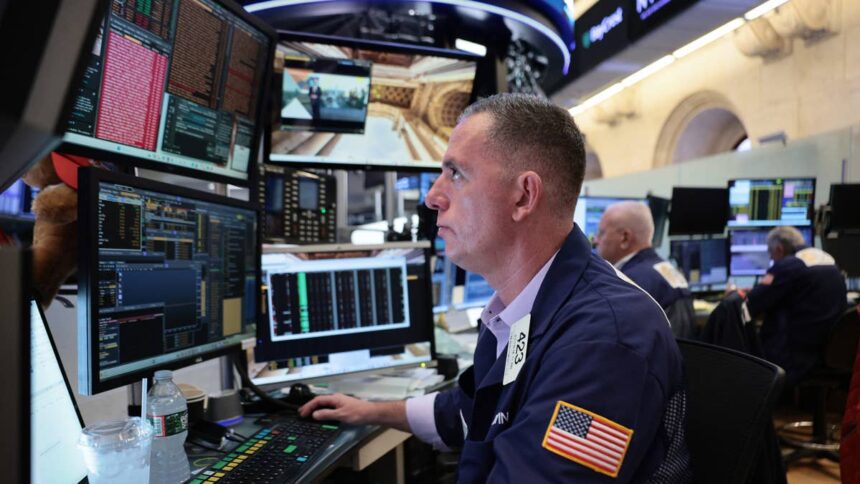
As Wall Street navigated the complexities of 2026, a central question emerged: Have stock market gains surged too quickly? Amidst this backdrop, analysts from Citi are adopting an optimistic stance as they revise their projections for the S&P 500, highlighting the potential for a significant profitability cycle driven by increased spending on artificial intelligence (AI) infrastructure.
Typically, stock market gains are derived from one of two sources: either investors are willing to pay higher multiples for the same earnings, or companies experience actual earnings growth, the latter providing a more stable foundation for market strength. Citi’s Scott Chronert emphasizes the second option, drawing attention to a forecast that leans heavily on genuine and sustainable earnings growth.
This revised outlook comes at a time when the markets are grappling with various challenges, including renewed inflation concerns, escalating tensions in the Middle East, and fears regarding sustained higher interest rates. The S&P 500 index recently closed at 7,383.74, reflecting a decline of 200.57 points, or 2.64%, after reaching a historic high of 7,609.78 earlier that week. This downturn can be traced back to an unexpectedly strong May jobs report, which indicated the U.S. economy added 172,000 jobs, stoking worries about the Federal Reserve potentially keeping interest rates elevated for an extended period.
Among the sectors impacted, chip stocks suffered significantly, with the Philadelphia Semiconductor Index experiencing a downturn exceeding $1 trillion in value. Major players such as Nvidia, Intel, AMD, and Broadcom were among the hardest hit. Despite this recent setback, the broader trend over the past three months has been positive, with the S&P 500 up 553.03 points, or 8.10%, since early March.
Citi’s analysts view the recent decline as a fleeting setback rather than a substantial shift, projecting that a wave of AI spending will create a meaningful impact on corporate earnings in the near future. Accordingly, they have adjusted their year-end 2026 S&P 500 target to 8,100, an increase from the previous estimate of 7,700. This revision represents a 5.2% boost based on anticipated stronger earnings, which are expected to reach $350 per share by 2026 and potentially rise to $400 by the following year.
Historically, the S&P 500’s performance over the last five years has set a solid foundation, providing visibility for future growth even if valuation multiples stabilize or decline. Although there are skeptics who warn about an impending AI bubble, citing dependency on investor enthusiasm, Citi remains steadfast in its belief that AI infrastructure investments are positively impacting corporate fundamentals, particularly among leading tech firms.
Citi points out that the sector closely associated with AI now represents approximately 45% of the S&P 500’s earnings weight, a substantial increase from just 15% three decades ago. This indicates that companies benefiting from AI spending now exert a more significant influence on overall market performance. However, as the AI cycle continues to mature, Citi anticipates that price-to-earnings multiples will eventually decrease.
Currently, the S&P 500 is viewed as having elevated valuations, with a trailing price-to-earnings ratio around 25.6. In contrast, forward-looking estimates place the 12-month forward P/E at 21.1, notably higher than the five-year average of 19.9.
With these insights and projections, Citi’s revised outlook aims to rekindle optimism on Wall Street amidst prevailing uncertainties, marking a potential turning point in the narrative surrounding market sustainability and growth.