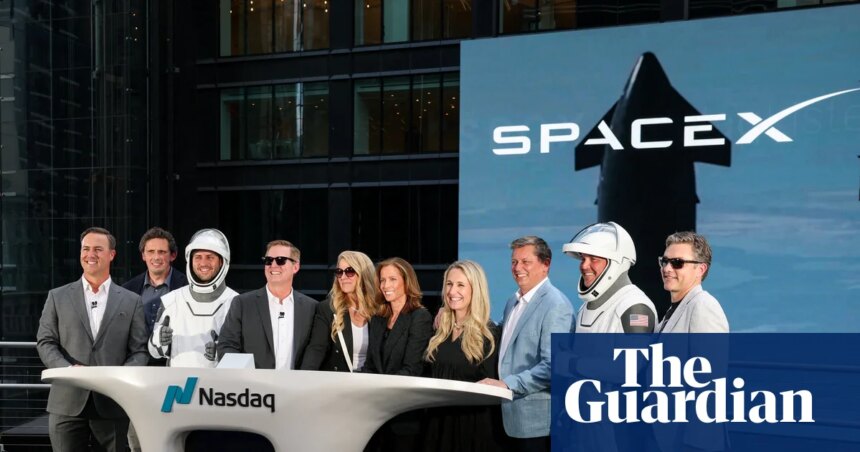
Elon Musk has recently achieved a historic milestone, becoming the world’s first trillionaire as SpaceX made its much-anticipated debut on the stock market, valued at a staggering $1.77 trillion. This development has sparked considerable reaction across the United States, particularly regarding how millions of citizens may soon serve as indirect investors in SpaceX and various emergent AI-focused companies, as the stock market increasingly pivots towards AI-driven investments.
A significant portion of Americans’ retirement savings is now closely tied to the market through private 401(k) plans, which often invest heavily in index funds tracking major stock indices. This means that even individuals who do not actively invest in these new technology firms may find their savings increasingly associated with them. The impact of Musk’s influence on the rules governing index fund investments could prolong this trend, potentially binding many Americans’ savings and pensions to his ventures and those of other AI companies.
Concerns about this situation were voiced after an inquiry was sent out by The Guardian, which sought to gauge public sentiment regarding the SpaceX initial public offering (IPO). Over 150 respondents expressed significant apprehension regarding their financial futures amid growing inequality, market volatility, and the sustainability of the ongoing AI boom.
For individuals like Tim, a 62-year-old engineer from Alameda, California, investing directly in SpaceX feels more like a necessity than a choice. “I’ve never wanted to participate in the so-called AI bubble,” he explained. “Basically my entire retirement is in the S&P 500. Not out of choice, but if you don’t have investments in the stock market, you’re losing ground compared to everybody who does.”
Stephen, a 33-year-old engineer from Michigan, echoed similar sentiments. He conveyed his disgust over the overwhelming influence of technology firms on retirement savings. “The amount is absolutely ridiculous and untethered to the company’s actual value,” he stated, condemning the intertwining of his savings with companies that seem to lack accountability.
Matt, a 57-year-old professor from eastern Washington, expressed unease over the ramifications of big tech’s dominance. He articulated worries about the future of his finances, lamenting the concentration of market power. “As someone looking to retire in the next five to 10 years, I’m alarmed at big tech’s market consolidation and its impact on my savings and investments,” he said, questioning the ethics of having his finances tied to wealthy tech figures.
Kendra Ford, a 54-year-old climate activist from Portsmouth, New Hampshire, framed the issue in moral terms, highlighting the contrast between immense wealth and the struggles of ordinary citizens. She remarked on the potential for social upheaval as those most affected by economic inequalities start to reject participation in the current system.
Contrastingly, some individuals, like Mia, a 58-year-old writer from Washington, D.C., have opted to entirely divest from the stock market as a protest against Musk’s ventures. “I have intentionally not invested in the stock market,” she commented. “It’s a money game for rich people.”
Pedro, a retired businessman from Denver, Colorado, has taken a proactive stance by divesting from index funds altogether, advocating for collective action to challenge the current framework. “If we all were to do that, it would drive those stocks back to reality,” he said, emphasizing his desire to send a message to corporate leaders.
On the other hand, some individuals see the IPO in a more favorable light, recognizing SpaceX’s significant achievements in advancing technology. Dimitris Eleas, a political scientist based in Brooklyn, expressed ambivalence, acknowledging the company’s transformative role while grappling with concerns about the concentration of wealth.
While sentiments are mixed, many shared a common frustration regarding the power dynamics in the tech sector. Steven, the engineer from Michigan, highlighted the palpable sense of unfairness in how the lives of everyday individuals are intertwined with major corporate decisions. “CEOs receive lavish sums of money even when they fail while our retirement funds and employment are married to the companies they run,” he lamented.
As the implications of SpaceX’s IPO continue to unfold, the debate around individual financial security, market integrity, and the ethical considerations surrounding wealth concentration presents a complex landscape for the future of both American investors and the broader economic system.