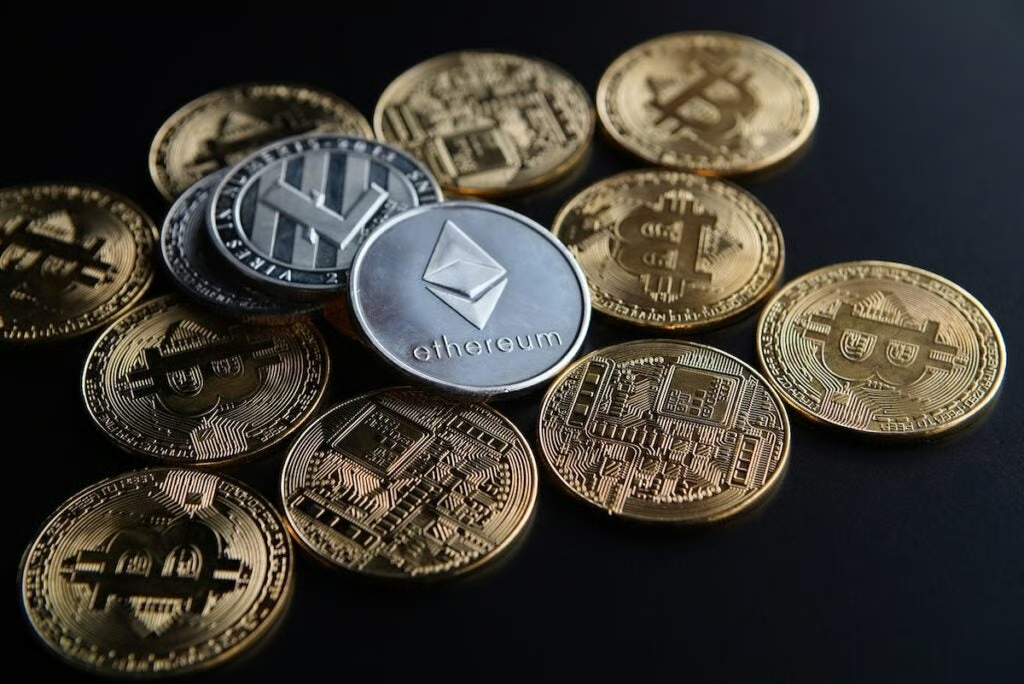
As the cryptocurrency market continues to be dominated by Bitcoin, Ethereum, and XRP, industry experts are speculating that lesser-known cryptocurrencies might offer significant returns by 2026. Among these, the Lighter Protocol is generating considerable buzz as it prepares to launch its LIT token before the year concludes.
Lighter recently secured a substantial funding round of $68 million, backed by notable investors such as Peter Thiel’s Founders Fund, Andreessen Horowitz, and Ribbit Capital. This decentralized exchange operates on a custom Ethereum Layer-2 zero-knowledge rollup architecture, which allows it to process tens of thousands of transactions per second with latency as low as 5 milliseconds. Its performance not only rivals major players like Coinbase but also upholds transparency with cryptographic proofs.
As of now, Lighter boasts a total value locked (TVL) of $1.4 billion and has achieved an impressive $2.94 billion in trading volume over the last 30 days. Recent activities included the transfer of 250 million LIT tokens from team wallets to distribution addresses, signaling a likely airdrop on the horizon. Polymarket odds for this airdrop have surged past 90%, supported by over $9.5 million in betting volume. Pre-market trading indicates LIT is priced around $3.48, with conservative estimates suggesting a target of $5-$6, translating to a potential 40-70% upside. Bullish analysts anticipate even higher targets, speculating over a 330% return if Lighter captures a significant market share from competitors such as Hyperliquid.
Another cryptocurrency generating attention is VeChain, which recently completed its Hayabusa hard fork on December 19. This upgrade transitions the platform to a Delegated Proof-of-Stake consensus mechanism and ensures compliance with EU regulations known as MiCAR. It introduced the StarGate 2.0 staking model, which has increased yield for stakers from 2% to over 9%. VeChain now supports over 350 business applications in various sectors, including logistics, luxury goods authentication, and pharmaceutical tracking, with notable clients like Walmart China and BMW employing its infrastructure. The total value locked in VeChain surged by 800% in Q3 2025 to reach $6.1 million. Currently trading at $0.053, conservative projections place it at $0.055, while bullish forecasts envision a rise to $0.37, anticipating mass adoption driven by EU Digital Product Passport mandates.
Meanwhile, Algorand is emerging as a promising choice for developers, trading at $0.11, which represents a 95% decline from its all-time highs. The recent launch of AlgoKit 3.0 is drawing developers to the platform, offering near-instant transaction finality and minimal transaction costs. Founded by Turing Award winner Silvio Micali, Algorand has the potential to handle nearly 1 million transactions daily. Its positioning for Central Bank Digital Currency (CBDC) infrastructure and real-world asset tokenization adds to its appeal. Conservative forecasts estimate a target of $0.14, while bullish scenarios could see Algorand reach $1.35 if it is selected by a major nation for CBDC infrastructure.
Lastly, Hedera, governed by Google and capable of processing over 10,000 transactions per second, is trading at $0.11 with a market cap of $4.5 billion. This hashgraph recently attracted applications for an exchange-traded fund (ETF), which could facilitate institutional investments. With conservative targets suggesting a rise to $0.25 and bullish estimates reaching $1.05, Hedera could see significant growth if ETF approvals and enterprise adoption pick up momentum.
Overall, while mainstream cryptocurrencies remain in the spotlight, these emerging projects exhibit significant potential for investors willing to explore beyond the conventional currency borders.