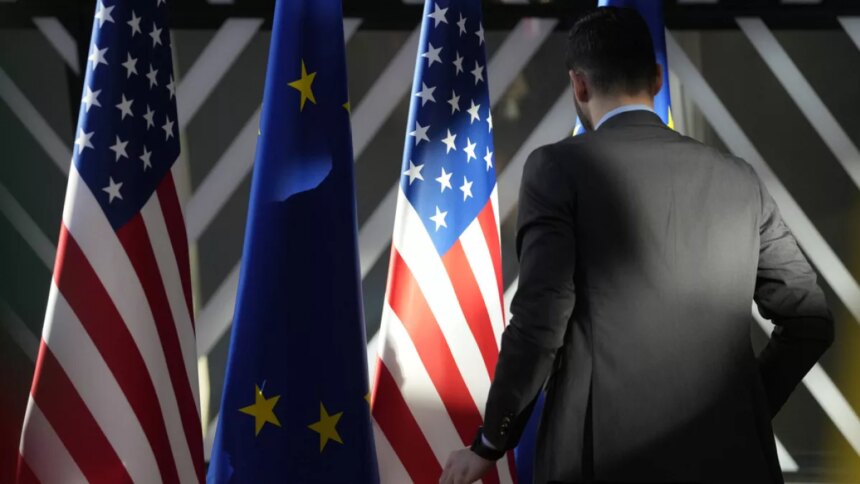
Pressure is mounting on European leaders to activate their trade response mechanism against the United States following President Donald Trump’s ultimatum regarding Greenland. Trump has threatened to impose tariffs ranging from 10% to 25% if Denmark does not agree to sell the territory by June. This situation has prompted calls for the European Union (EU) to utilize its anti-coercion instrument, a tool crafted to counteract economic intimidation by major global players, notably the US and China.
The anti-coercion tool, introduced in 2023, aims to address economic coercion as defined by instances where one nation applies or threatens trade measures to manipulate the actions of another country or the EU itself. Trump’s verbal threats are being viewed as a potential case of economic coercion, prompting discussions within EU circles about how to respond.
Last year, the EU considered various retaliatory options in response to potential US tariffs that could adversely affect European industries. Although plans were laid out to target approximately €93 billion worth of American goods, including bourbon and airplane parts, the EU ultimately opted for a strategy that tripled tariffs on European goods to 15% while eliminating duties on American industrial products. This approach, although deemed imbalanced, was justified by the EU as a means to establish clarity and stability in troubled geopolitical waters.
However, the anti-coercion tool, often referred to as a “trade bazooka,” represents a more aggressive response. It enables the EU to restrict access to its vast single market of 500 million consumers, limit trade licenses, and curtail participation in public procurement tenders, targeting US services and businesses significantly.
Implementing the anti-coercion mechanism is not instantaneous. Once the EU assesses a potential coercion case, a four-month evaluation period follows, during which member states must collectively decide whether to activate the instrument. If they proceed, negotiations will commence. Should these discussions stall, the EU retains a toolbox of options that extend beyond just tariffs, including the exclusion of foreign companies from tenders.
The potential activation of this tool carries significant implications for the EU. Concerns remain among member states regarding the uncertainty of political and economic outcomes. Countries like Germany and Italy are particularly wary of rapid deployment without solid justification, recalling recent negotiations with the US.
While contemplating the use of the anti-coercion tool in response to China’s manipulation of critical resources, the EU has historically favored dialogue over confrontation. This reluctance underscores the delicate balance the EU seeks to maintain in its transatlantic relations, especially considering ongoing strategic partnerships through NATO and attempts to resolve geopolitical conflicts such as the situation with Ukraine.
The exigency surrounding Greenland has escalated the dialogue among EU leaders, with unified statements professing solidarity with Denmark. If the EU does decide that Trump’s actions warrant a response, the likelihood of escalating trade tensions grows substantially. Denmark has firmly rejected the idea of negotiating the sale of Greenland, contrasting sharply with the EU’s previous negotiations with the US.
If tariffs against Denmark and allied nations are enacted come February, a new trade war could ensue, reshaping the EU-US trade landscape and prompting Congressional reactions as midterm elections approach. The resolution remains uncertain, but if action is taken, it will signify the EU’s determination to uphold the rights of its member states against external pressures.