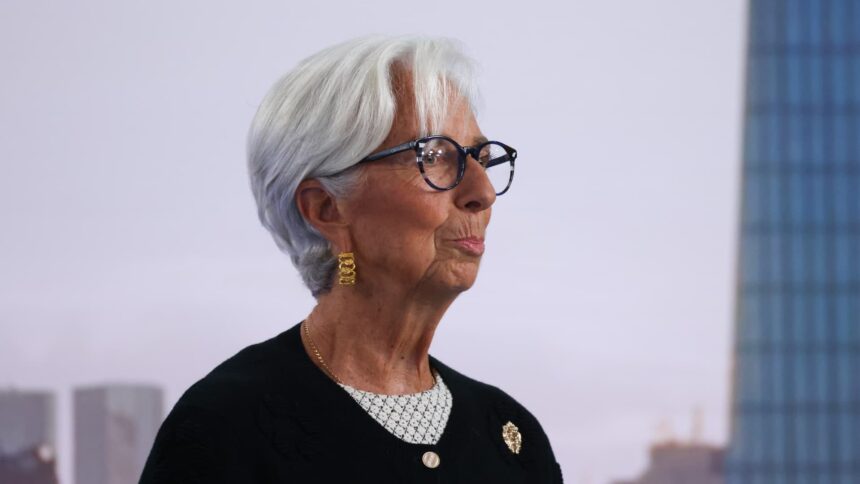
The European Central Bank (ECB) announced on Thursday that it would maintain its key deposit facility rate at 2%, marking the second consecutive month of unchanged rates amidst ongoing global economic uncertainty, particularly linked to U.S. trade policies. This decision aligned with market expectations, which had indicated a 99% probability of rates remaining steady.
In its statements, the ECB highlighted that inflation in the euro zone has stabilized around the medium-term target of 2%. The Governing Council emphasized its commitment to adopting a flexible, data-driven approach in its future meetings, refraining from committing to a specific trajectory for interest rates. The lack of clear guidance on future monetary policy has contributed to cautious anticipation among economists and analysts.
Despite inflation holding steady, the ECB is confronted with persistent economic uncertainty. This comes in the wake of a recent trade agreement between the European Union and the U.S., featuring a 15% blanket tariff on EU exports. While the deal provided some clarity for certain sectors, such as pharmaceuticals, significant concerns remain regarding its broader implications. Notably, unresolved issues pertaining to the wine and spirits sector continue to sow doubt among affected industries. Additionally, fears have intensified regarding potential further tariffs following announcements of retaliatory measures from U.S. President Donald Trump against the EU.
Amidst this backdrop, the euro zone’s economic growth has remained sluggish, with a mere 0.1% growth recorded in the second quarter—a stark contrast to the previous quarter’s 0.6% increase. ECB President Christine Lagarde acknowledged that while the risks to economic growth appear more balanced, the overall outlook remains fraught with uncertainty related to trade policies. She noted that renewed tensions could adversely affect export levels, investments, and consumer spending.
Lagarde’s remarks also indicated a moderate decrease in trade uncertainty, although she cautioned that it has not returned to pre-COVID levels, hinting at a new normal in economic relations.
As economists analyze the potential for future rate cuts, opinions are divided. Some, like Thomas Pugh, chief economist at RSM, suggest that while the ECB is under no immediate pressure to cut rates further, ongoing trade tensions and their effects on demand could leave room for a reduction later in the year. Conversely, Irene Lauro, an economist at Schroders, argued that the latest announcements signal the end of the easing cycle, noting that the economic landscape is shifting from trade uncertainty to political stability concerns—particularly in France—while domestic demand remains strong enough to support unchanged monetary policy.
The focus of Thursday’s meeting also turned to updated forecasts for inflation and economic growth, which were last revised in June. The ECB’s latest projections forecast headline inflation to average 2.1% in 2025, with subsequent years seeing averages of 1.7% in 2026 and 1.9% in 2027. Core inflation is anticipated to remain steady at an average of 2.4% for the year. Regarding economic growth, the ECB projects a rise to 1.2% in 2025, an upward revision from earlier estimates of 0.9%, although growth forecasts for 2026 have been slightly reduced to 1%.
Overall, the ECB’s decisions and projections reflect a complex interplay of inflation stability against a backdrop of global trade dynamics and domestic economic health.