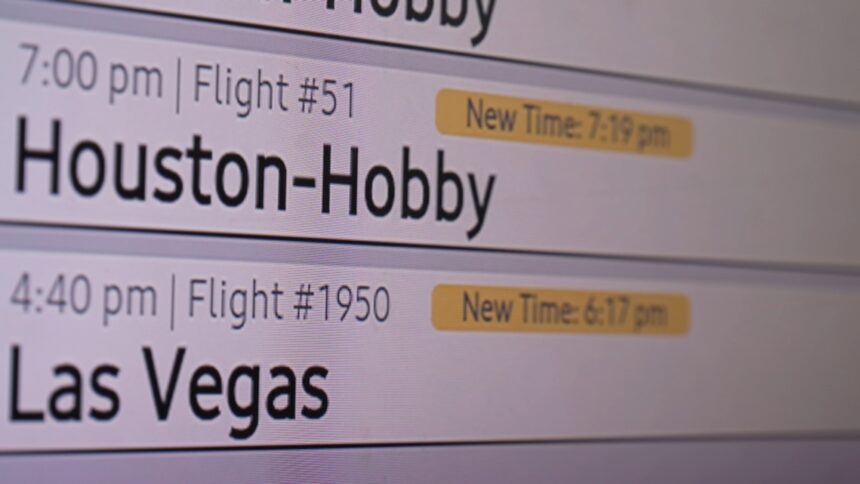
Hundreds of flights faced significant delays and cancellations at Dallas airports on Friday due to a telecommunications equipment issue, posing a challenge for travelers navigating one of the nation’s busiest air travel hubs.
The Federal Aviation Administration (FAA) reported that operations at Dallas Love Field and Dallas-Fort Worth International Airport were disrupted by a malfunctioning local telephone company’s equipment—an issue separate from FAA facilities. The FAA is currently collaborating with the telecom provider to identify the root cause of the problem, which had a dramatic impact on air traffic communications.
Matt Yonchak, a passenger traveling through Dallas Love Field, expressed his frustration with the situation, noting a string of delays. “Honestly, I have the worst travel luck ever,” he said. Throughout the day, he experienced incremental delays of about 30 minutes with Southwest Airlines, reflecting the systemic disruptions caused by the telecom issue.
Officials reported that the problem resulted in a complete loss of radar and phone communications, leading to a significant slowdown of flight operations in the area. “The entire metroplex took a hit,” an air traffic control official recounted in communications during the onset of the service disruption.
For many travelers, the fallout was immediate and frustrating. Mel Lam, whose fiancé was stranded in Ohio due to a canceled flight, described her futile attempts to find alternate travel arrangements. “I tried to get a flight even to Austin. I could just drive from there since it’s three hours from Dallas, but nothing was available,” she lamented.
At Dallas-Fort Worth International Airport, WFAA reporter Tiffany Liou observed a chaotic scene as passengers scrambled to rebook their travel. The ground stop instituted by the FAA meant that many travelers faced hours of uncertainty and potentially days in the recovery process for their travel plans.
American Airlines, one of the major carriers in the region, announced that travelers affected by the delays and cancellations would be permitted to rebook their flights without incurring any change fees. Nonetheless, passengers voiced concerns regarding the reliability of the technology that underpins air travel operations. Lam emphasized the need for better technological solutions to avoid such disruptions in the future.
Importantly, the FAA clarified that this latest incident was not connected to longstanding issues affecting air traffic management, including concerns regarding aging equipment or the national shortage of air traffic controllers. The federal government is currently undertaking a significant overhaul of aviation technology, bolstered by a recent allocation of $12.5 billion from Congress, along with plans to recruit thousands more controllers. However, these improvements are expected to take years to implement.
As travelers like Yonchak anxiously awaited updates, he voiced a common sentiment: “Right now, just hoping that the phone company gets their stuff together.” FlightAware data indicated that over 550 flights were delayed at DFW Airport alone, amplifying the frustration of countless passengers navigating the chaotic travel environment. The fallout from this local telecommunications issue serves as a reminder of the vulnerabilities within the interconnected systems that support modern air travel.