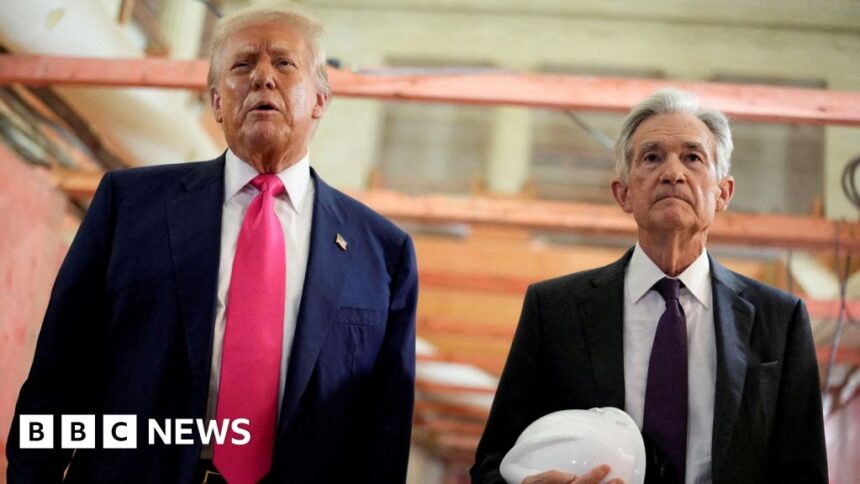
In a notable and unexpected statement, Jerome Powell, chair of the Federal Reserve, addressed the public through a video posted on social media, stirring considerable attention and speculation. The controversy stems from President Trump’s overt attempts to influence the independent operations of the central bank, specifically regarding interest rate decisions, and now includes an unsettling escalation involving criminal investigations.
Powell revealed that the Department of Justice (DoJ) has issued criminal indictments related to his testimony concerning renovation costs at the Fed’s headquarters. The investigation has underscored an ongoing tension between the Federal Reserve and the Trump administration, which has faced criticism for attempting to exert political pressure on the Fed’s operations.
During his address, Powell highlighted that the indictments should be viewed in the context of broader threats and intimidation from the administration. He suggested that the focus on the building renovations serves as a pretext for undermining the Fed’s independence, emphasizing that the institution must continue to set interest rates based on objective economic assessments rather than political whims.
The implications of Powell’s statements extend beyond the immediate scenario in the U.S. The independence of central banks is crucial for maintaining stability in global markets, with historical examples illustrating the risks when political influence compromises monetary policy. Powell noted that the ability of the Federal Reserve to base its decisions on sound economic evidence is paramount and that any shift toward prioritizing political preferences could jeopardize market confidence.
The situation draws parallels with past instances, particularly in emerging economies like Turkey, where government pressures have destabilized independent monetary institutions. Powell’s remarks raised significant questions about the future of the Fed’s operational autonomy, as well as the potential repercussions for U.S. financial markets, notably in the treasury market, which serves as a safe haven during economic instability.
Speculation continues regarding Powell’s position, as his term is set to expire in May, potentially opening the door for Trump to appoint a more favorable figure. Regardless, Powell emphasized that interest rate decisions are determined by a committee, suggesting that any sustained pressure could impact broader policies.
Moreover, concerns linger around the U.S. administration’s potential use of the Fed’s powerful financial tools in its tariff war, raising the stakes significantly. The capability to use swap lines, which allow for massive dollar funding during times of stress, is a critical tool that Powell’s governance has safeguarded. Analysts are questioning whether such actions could alter the landscape of domestic and international economic policy.
This unprecedented direct appeal from Powell comes amidst a backdrop of wider political turmoil in the country, featuring militarized immigration policies and contentious immigration debates. It reflects a broader struggle between forces of political power and institutional integrity within the U.S. government.
As markets respond to Powell’s unusual intervention, there is a creeping apprehension within certain political factions regarding the implications of an independent central bank in the current administration. The ramifications of Powell’s statements may reverberate throughout the economy, influencing the decisions and trust of global markets, reminiscent of key moments in past financial crises.