Ford Motor Company has announced a significant shift in its executive structure, coinciding with the departure of Doug Field, its chief electric vehicle, digital, and design officer. Field, who joined Ford in 2021 after notable stints at Tesla and Apple, will exit the company following a transition period of about a month.
The announcement details a new organizational framework, highlighted by the formation of a “Product Creation and Industrialization” unit, which will be spearheaded by Chief Operating Officer Kumar Galhotra, a company veteran. This restructuring aims to integrate Field’s previous responsibilities with Ford’s global Industrial System group, intending to streamline operations and help meet objectives outlined in the company’s “Ford+” business plan. Notably, this plan targets achieving an adjusted EBIT margin of 8% by 2029.
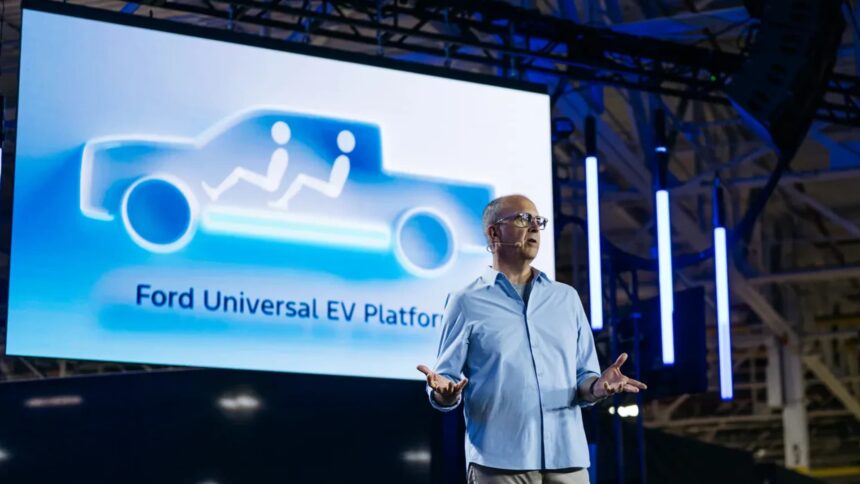
CEO Jim Farley emphasized the significance of this restructuring, referring to it as a pivotal moment for Ford. He expressed confidence that these organizational changes would bolster the company’s ability to meet its goals, particularly in light of a forthcoming new generation of electric vehicles. Farley and Field discussed an upcoming midsize pickup truck built on Ford’s “Universal Electric Vehicle” platform, slated for launch next year, indicating that the transition of leadership would not hinder this product’s development.
Ford’s new Product Creation and Industrialization unit has been described as an “end-to-end organization” designed to manage one of its most extensive rollouts of products, software, and services. The automaker plans to refresh 80% of its North American portfolio and 70% of its global offerings by 2029, which will include high-profile models such as the UEV pickup truck and next-generation F-150.
Farley articulated the vision behind these initiatives, deeming this restructuring as the “heart and soul” of Ford’s upcoming transformation. The automaker aims to ensure that by 2030, 90% of its global lineup includes electrified powertrains, which encompass hybrids, extended-range electric vehicles, and fully electric models.
Ford is also focusing on upgrading its vehicle architectures and developing in-house user experiences alongside enhancing capabilities for over-the-air updates. This technological advancement is expected to facilitate a more rapid rollout of improvements, particularly for their BlueCruise advanced driver assistance system, aiming toward a future where drivers can experience hands-free driving by 2028.
Despite these ambitious plans, Field’s exit underscores challenges Ford has faced in its EV and software initiatives. The company has dealt with sizable setbacks in expected software revenue and previously announced a significant write-down of $19.5 billion related to a strategic pivot in its electric vehicle approach.
As part of the broader leadership shakeup, Ford has initiated various changes across its advanced vehicle development and European manufacturing sectors. Galhotra remarked on this unified organizational approach as positioning Ford to deliver high-quality vehicles and advanced digital experiences on a profitable scale.