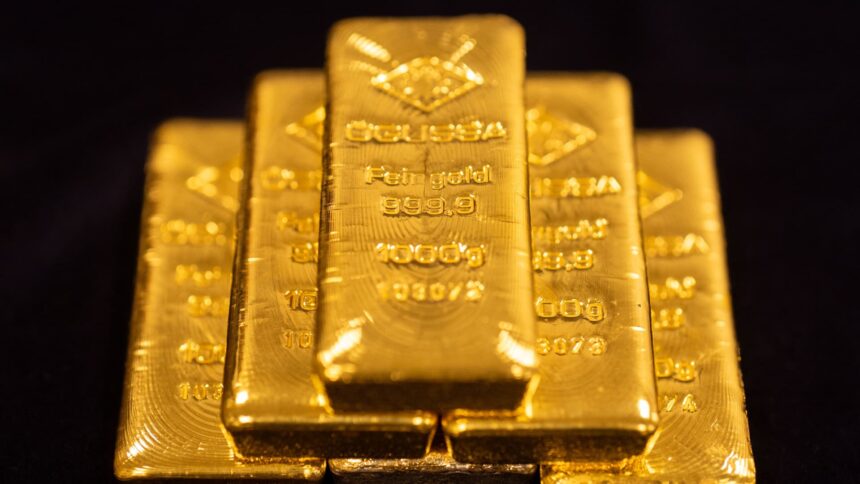
Gold prices continued to demonstrate significant volatility as they remained entrenched in a bear market phase, marked by a notable decline on Tuesday. Investors were observed unwinding their positions in reaction to a stronger U.S. dollar and elevated Treasury yields, both of which diminished the appeal of the precious metal.
At one point during trading, spot gold prices fell by 2%, before stabilizing to hover around $4,404.79 per ounce. Meanwhile, gold futures for April delivery were reported at approximately $4,358.80 per ounce. The dollar index, which gauges the greenback’s value against a selection of currencies, climbed by 0.5% on the same day. With a stronger dollar, gold, priced in U.S. currency, becomes more expensive for international buyers, contributing to the decline in demand.
Since hitting a record high of $5,594.82 per ounce at the end of January, spot gold has now shed over 21% of its value. The past week alone saw the yellow metal decrease by nearly 10%, marking its steepest drop since September 2011. Over the same period, the dollar index has appreciated approximately 3%, coinciding with recent geopolitical tensions.
Market analysts attribute the downward trend in gold prices to a combination of macroeconomic factors and tactical positioning. Rajat Bhattacharya, a senior investment strategist at Standard Chartered, explained that although gold initially attracted safe-haven investments due to the onset of conflict, recent price corrections have surfaced as investors liquidate positions to raise cash for margin calls or to realize profits. He also noted that the dollar’s strength has further pressured gold demand.
Additionally, market participants are reevaluating expectations surrounding U.S. monetary policy. Persistent inflation appears to make aggressive interest rate cuts by the Federal Reserve less likely, thus keeping Treasury yields elevated. The yield on 10-year Treasuries edged higher to around 4.384% on Tuesday, further diminishing gold’s allure as a non-yielding asset.
Some analysts consider the current sell-off a natural correction following a substantial rally driven primarily by geopolitical uncertainties and consistent demand. Gold experienced remarkable gains last year, soaring over 64%. Zavier Wong, a market analyst at eToro, observed that gold’s recent ascent was largely influenced less by inflation than by broader factors such as fiscal deficits, geopolitical disarray, and ongoing diversification away from dollar reserves by central banks.
As bearish sentiment grows among investors concerning gold, industry experts maintain a broadly optimistic long-term outlook. They argue that underlying structural drivers—including geopolitical risks, fiscal instabilities, and robust central bank demand—will support the long-term bullish narrative for gold in the coming years.