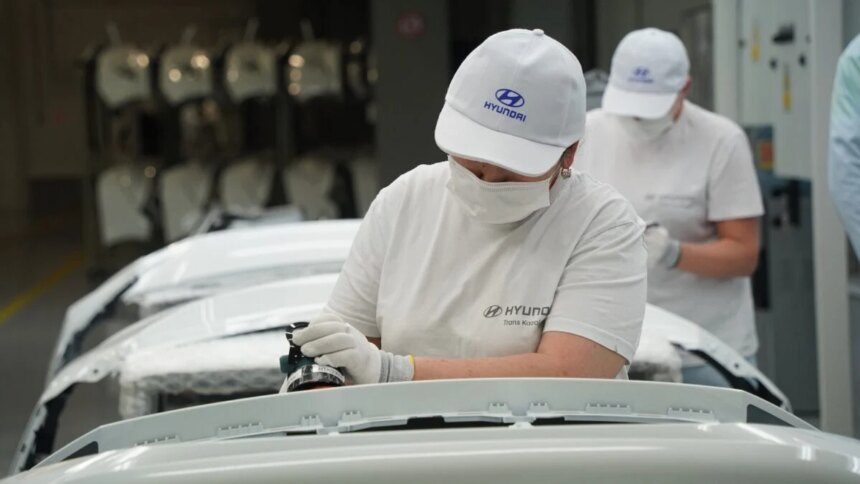
At the recent CES event, Hyundai made significant waves in the automotive and robotics industries, particularly as a potential challenge to Tesla’s dominance in investor appeal. Although Hyundai is not proclaiming that robots will take over the world, their emphasis on substantial production capabilities has raised eyebrows, especially when compared to Tesla’s output. Over the last three years, Hyundai has consistently produced about 7 million vehicles annually on a global scale, while Tesla’s numbers lingered around 1.8 million.
The fascination with Tesla, however, is not rooted in its current production figures but rather in the narratives surrounding the company, primarily driven by Elon Musk’s ambitious vision for a future dominated by autonomous vehicles and groundbreaking robots. Musk’s assertions that Tesla’s robots could eliminate poverty and potentially generate “infinite” revenue have made headlines, positioning the company as a Wall Street favorite.
Yet, doubts loom over Tesla’s robotic ambitions. Musk’s past attempts to showcase a robot prototype were met with skepticism when the reveal turned out to be a person clad in a lycra bodysuit, reducing the announcement to a less-than-serious debugging debacle. Hyundai, in contrast, boasts a partnership with Boston Dynamics, a well-established entity known for developing advanced robotics for nearly three decades. Boston Dynamics has become synonymous with cutting-edge technology and viral robotics, potentially placing Hyundai in a stronger position within the robotics sector.
At CES, Zachary Jackowski, the head of the Atlas program at Boston Dynamics, presented a more concrete vision for the future. He described the company’s advancements toward producing the Atlas robot, which they claim will be the most sophisticated and user-friendly model yet. Promising resilience to various environmental conditions, including extreme temperatures and water resistance, Jackowski mentioned the development of a “new robotics factory” capable of producing up to 30,000 Atlas robots annually.
Despite the excitement, skepticism persists regarding the authenticity of Hyundai’s claims versus the speculative promises of Tesla. Analysts are left pondering whether Hyundai’s push for robotics is merely an attempt to reassure investors and appease those eager to reduce labor costs, or if it is genuinely aimed at making strides in humanoid technology.
On the other side, Elon Musk has staked a sizable portion of his compensation on the successful deployment of 1 million Optimus robots, emphasizing the pressure underlying his ambitious targets. Current timelines have shifted, with Musk postponing the operational launch of these robots initially slated for work in Tesla factories by 2025, with commercial availability by 2026. The narrative around Optimus continues to evolve, with Musk drawing whimsical comparisons to beloved cinematic robots like C-3PO and R2-D2.
As the competition between Tesla and Hyundai unfolds, the focus shifts from simply rooting for one company over the other to evaluating the plausibility of their respective futuristic narratives. Both companies face significant challenges ahead, raising the question of which approach—Tesla’s aspirational vision or Hyundai’s robust production capabilities—will resonate more with investors and consumers alike.