The stock market has experienced significant volatility this year, but recent developments suggest a potential upward trajectory. Contrary to a typical market crash, investors are now considering the possibility of a stock market melt-up, marked by rapid gains as various factors align positively.
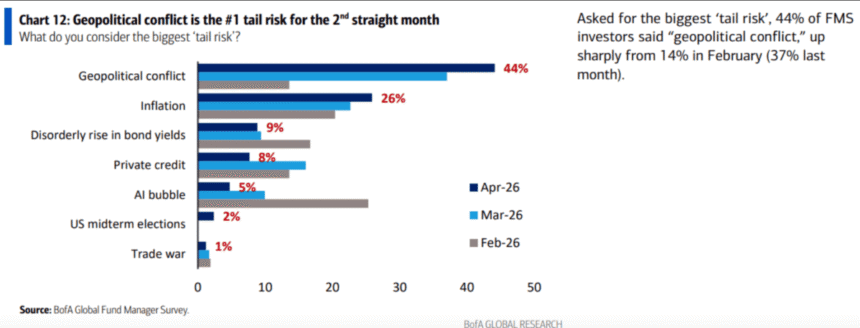
According to a recent survey by Bank of America, fund managers have identified several tail risks that could threaten the stock market. However, many of these concerns have lessened, particularly in the Middle East, where the situation appears considerably more stable. Analysts point out that military operations in the Persian Gulf, especially around Kharg Island, are less likely during the hotter months from May to September, due to the extreme conditions. Furthermore, the U.S. military’s rapid consumption of munitions has introduced a degree of restraint against further escalations.
Despite the positive outlook, experts caution against entirely dismissing the risk of a market crash. It’s also essential for investors to remain vigilant about the potential for significant upward movements in stock prices. This leads to the critical question of what strategies investors should adopt in anticipation of a melt-up.
Expert advice suggests that rather than resorting to indiscriminate buying, investors should conduct a thorough assessment of stock valuations. A practical approach involves performing a reverse discounted cash flow (DCF) calculation. This method allows investors to establish a reasonable purchase price by taking into account a desired rate of return along with the company’s enterprise value and cash flows. The calculation then reveals an implied growth rate, which investors can evaluate for plausibility.
One stock gaining attention is Informa, a member of the FTSE 100 that specializes in organizing trade shows and conferences. Recent purchases of Informa shares signify confidence in its potential. However, the question remains whether the stock would still hold value after a potential 20% surge.
From a valuation perspective, Informa has an enterprise value of £13.94 billion and generated £849 million in free cash flow in 2025. With a desired return rate of 9%, a 20% increase in the stock would elevate the enterprise value to £16.08 billion. This scenario implies a necessary growth rate of just 3.5% annually—an achievable target given Informa’s status as a leader in its field with strong unit economics.
While global economic downturns could pose a threat to sales in the short term and the company’s significant exposure to the Middle East presents inherent risks, Informa has set ambitious targets of 5% annual sales growth and 8% increase in earnings per share in the medium term. These goals exceed the company’s necessities for sustainable growth, making it a compelling consideration for continued investment, even amid a bullish market outlook.
In summary, while optimism pervades the market landscape, investors should engage in careful analysis of each stock’s fundamentals, preparing strategically for potential upward movements while remaining cautious of inherent risks.