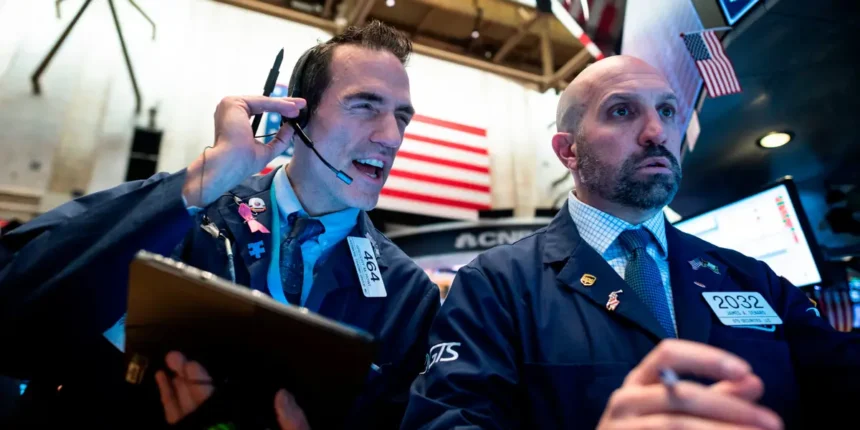
There’s a growing concern among investors on Wall Street about a potential scenario where the current bull-market rally, which has propelled stocks back to all-time highs, may culminate in a sudden spike followed by a significant downturn. This anxiety is fueled by ongoing geopolitical tensions, particularly the continuing conflict involving Iran, which has cast a shadow over market optimism.
The S&P 500 index experienced a 7% decline from the onset of the Iran war through late March but has since rebounded by 12%, reaching record levels. This resurgence appears to be largely driven by hopes for a resolution to the conflict, especially following an extension of the ceasefire between the U.S. and Iran. However, as stocks ascend, skepticism is creeping in among some analysts who believe this latest surge may lead to disappointment for investors.
Mark Spitznagel, Chief Investment Officer at Universa Investments, has intensified his predictions that the market could be on the verge of a “blow-off top” rally amid the ongoing conflict, with projections suggesting the S&P 500 might reach 8,000 points before experiencing a steep drop. Spitznagel, who has anticipated a rally followed by a market bust for several years, previously likened the potential decline to the infamous stock crash of 1929. He cautioned that investors who are optimistic today but were not so just a few years ago should reconsider their investment strategies.
Economist David Rosenberg, founder of Rosenberg Research, echoed similar sentiments regarding the potential for a sharp rally, likely fueled by a fear of missing out (FOMO). He referenced historical trends, noting that many investors may still be haunted by memories of previous market surges, like the one seen after President Donald Trump softened his stance on global tariffs. While acknowledging that the rally could continue, Rosenberg warned that the current market dynamics leave it vulnerable to disappointment and further declines. He characterized the recent bounce as less of a stable upward movement and more of a temporary squeeze that could eventually lead to a corrective phase unless a significant policy change occurs.
Goldman Sachs has also raised alarms about the possibility of an impending stock decline, despite the current bullish rally affecting risky assets. Although the bank maintains its target of 7,600 for the S&P 500 by the year’s end, analysts caution that the risk of another downturn remains heightened following the recent rally. They emphasize that despite the current momentum, a consolidation phase is likely as early as next month.
Mark Newton, head of technical strategy at Fundstrat Research, supports this cautious outlook, suggesting that the recent surge will necessitate a period of consolidation in May. He advises investors to monitor for signs of trend deterioration before deciding to exit positions during this rally.
Additionally, Kevin Dempter, a technical analyst at Renaissance Macro Research, has observed indicators suggesting a new “momentum thrust” may be starting. This includes an increasing percentage of stocks showing gains over a 10-day period. Nevertheless, he notes that the positioning within the S&P 500 appears to be nearing “bullish extremes,” suggesting that while short-term momentum may remain favorable, the market is in a late-stage phase which carries heightened risks of a speculative blow-off top reminiscent of the market dynamics in 1999.