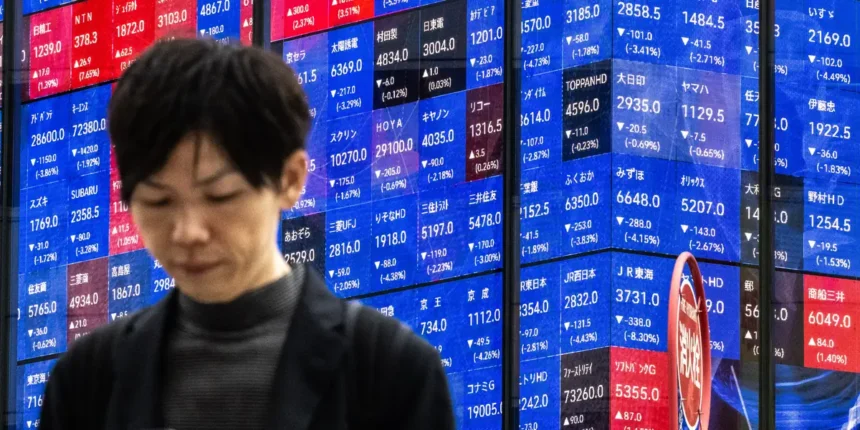
A wave of renewed optimism swept across Japan’s financial markets as the country returned from a series of public holidays, leading to remarkable gains in the stock market. On Thursday, Japan’s benchmark Nikkei 225 index soared by an impressive 5.7% in its first trading session of the week, exceeding the pivotal 62,000 mark for the first time. This surge was predominantly driven by strong performances in technology stocks and a growing belief that escalating tensions in the Middle East might ease, particularly following reports hinting at a potential peace agreement with Iran.
Among the standout performers were companies associated with the semiconductor supply chain, such as Renesas Electronics and Ibiden. Investors showed a keen interest in firms tied to the burgeoning artificial intelligence sector, which continues to attract significant capital as excitement around AI advancements grows. This bullish sentiment in Japan’s market occurred against a backdrop of robust performances in global markets while Japan was largely inactive from Monday to Wednesday.
In the U.S., both the S&P 500 and Nasdaq indices achieved new record highs earlier this week, indicating a broader trend of rising equity markets. South Korea also experienced a sharp rally in its stock market, contributing to the global uptrend. Analysts from ING noted that equity investors are actively seeking to invest, buoyed by positive developments emerging from the Gulf region, although they cautioned that the market’s enthusiastic response might be somewhat excessive. Nonetheless, they affirmed that the prevailing mood remains optimistic, as investors foresee continued growth driven by the AI-related tech boom.
The ripple effects of this positive sentiment were also evident in the currency markets. The U.S. dollar, which had gained strength during recent geopolitical instabilities as investors sought refuge in safe-haven assets, weakened this week amid decreasing fears of escalation. In contrast, the Japanese yen reached a 10-week high, trading close to 155 yen per dollar on Wednesday. This climb followed significant fluctuations in the currency, reigniting discussions about potential intervention from Japanese authorities, especially after the yen had briefly stabilized around 157, just crossing the vital 160 threshold.
While there has been no official confirmation from Tokyo regarding any intervention, Japanese officials have issued warnings against speculative activities in the currency markets in recent months. Over the past year, the yen has remained approximately 7% weaker against the dollar, a situation that has prompted speculation about government actions. Analysts from MUFG indicated that any potential intervention by Japanese authorities might increasingly be influenced by unpredictable geopolitical events rather than solely by domestic economic policies.
Japan’s stock market has established itself as one of the most dynamic globally in recent years, bolstered by significant corporate governance reforms, a weaker yen, and rising hopes of an end to decades of deflation. Investors seem eager to capitalize on these trends, further fueling Japan’s vibrant economic landscape.