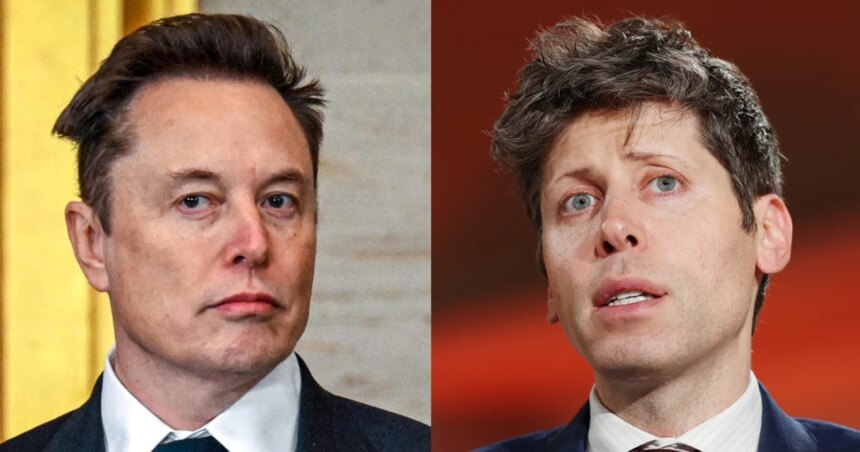
In an unprecedented legal showdown in Oakland, California, jury selection commenced on Monday for a civil trial that pits two tech billionaires against each other: Elon Musk and Sam Altman. The case stems from an intricate mix of personal grievances and business disputes, with potential implications for the future of OpenAI, the organization behind the popular AI application ChatGPT.
The trial is set to run for four weeks and will feature a host of high-profile tech executives scheduled to testify, including Musk, who heads Tesla and SpaceX, and Altman, the CEO of OpenAI. Moreover, it is anticipated that Microsoft CEO Satya Nadella, along with current and former board members of OpenAI and leading AI researchers, will provide testimonies. Judge Yvonne Gonzalez Rogers, presiding over the case, aptly remarked, “Billionaires versus billionaires,” during a previous hearing.
At the crux of the litigation is the contentious transformation of OpenAI, originally founded as a nonprofit research entity in 2015, into a for-profit organization that has attracted billions in external investments. Musk, who co-founded OpenAI, argues that this shift represents a betrayal of the organization’s founding ethos. He alleges that Altman and others misled him regarding their commitment to a mission-driven endeavor, ultimately profiting from the venture he believed should remain publicly oriented. Musk filed suit against Altman and a slew of co-defendants in 2024, initially seeking restitution amounting to $134 billion.
In contrast, Altman’s defense maintains that Musk’s claims distort the facts. They point to Musk’s departure from OpenAI in 2018 and his failure to fulfill a pledged $1 billion investment as evidence of his ill will. Furthermore, they argue that Musk had previously agreed to the necessity of converting OpenAI into a for-profit structure to secure funding, claiming he harbored ambitions to integrate OpenAI into Tesla.
Both Musk and Altman have expressed eagerness for the trial proceedings. Musk has hinted at the dramatic revelations expected during testimonies, while Altman looked forward to having Musk testify under oath, labeling the trial as a highly anticipated moment.
The two moguls share similarities as tech pioneers with substantial interests in AI, yet they also embody stark contrasts. Musk, at 54, is nearly twice Altman’s age. Their political affiliations diverge, with Musk engaging in far-right Republican politics and Altman aligning more with Democratic ideals. The personal nature of their feud is underscored by social media exchanges, with Musk referring to Altman disparagingly, while Altman sought to reclaim a deposit for a delayed Musk vehicle.
The timing of the trial is particularly significant, as OpenAI is currently embroiled in a competitive race against companies like Anthropic and Google for dominance in the rapidly evolving AI market. This competitive atmosphere and growing public scrutiny of AI technology have only intensified the focus on the litigation.
Should Musk prevail, the ramifications for OpenAI could be far-reaching. He has signaled intentions to request $134 billion from both OpenAI and its financial backer, Microsoft, and to seek the ousting of Altman and another co-founder, Greg Brockman. OpenAI, for its part, has referred to Musk’s demands as a “legal ambush” in the run-up to the trial.
Musk asserts that he contributed $38 million during OpenAI’s formative years, constituting 60% of its initial funding. The jury in this case will serve in an advisory capacity, with Judge Gonzalez Rogers making the final determination on liability and any potential remedies. She has previously admonished both sides for over-litigating the issue, emphasizing her commitment to efficiency in judicial proceedings.
As the trial begins, the broader tech community is buzzing with anticipation, not only for its implications regarding OpenAI but also for the sensational anecdotes and internal documents that might emerge. One such document included Brockman’s own notes reflecting aspirations of wealth, while another featured Musk’s prior communications expressing skepticism about Amazon’s Jeff Bezos.
Judge Gonzalez Rogers, with extensive experience in high-stakes tech litigation, has indicated a no-nonsense approach to this case, instituting standard security protocols for all courtroom attendees, regardless of their wealth or status. The jury, comprised of nine members from San Francisco and surrounding areas, will be tasked with evaluating the evidence, but their ability to remain impartial given Musk’s controversial public persona remains uncertain. This trial will undoubtedly capture the spotlight, impacting not just the parties involved but potentially reshaping the future of the AI industry itself.