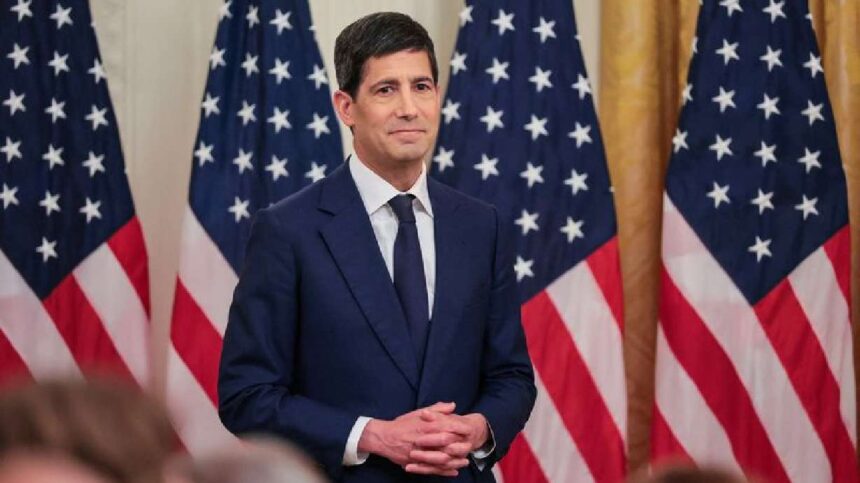
Kevin Warsh has officially taken office as the new chair of the Federal Reserve, navigating into a complex economic landscape marked by rising inflation and waning consumer confidence, exacerbated by the ongoing war in Iran pushing gas prices above $100 a barrel. Warsh was sworn in during a ceremony in the East Room of the White House, officiated by Supreme Court Justice Clarence Thomas, and attended by key figures, including President Donald Trump, Treasury Secretary Scott Bessent, and former Secretary of State Condoleezza Rice.
In his remarks, Warsh expressed that it was an “honor of a lifetime” to return to public service and pledged to lead a reform-oriented Federal Reserve, drawing on lessons from both past successes and failures. He emphasized the dual mandate of the Fed: to promote price stability and maximum employment. “When we pursue those aims with wisdom and clarity, independence and resolve, inflation can be lower, growth stronger, and America can be more prosperous,” he stated.
At the same time, consumer sentiment has hit a record low according to the University of Michigan’s Surveys of Consumers, indicating growing concerns among the public about economic stability, especially among Republicans and independents. Trump, who has been vocally critical of previous Chair Jerome Powell for not reducing interest rates, indicated his full support for Warsh while cautioning that “growth does not mean inflation.”
The economic backdrop is charged with uncertainty as the Fed contemplates its next steps. Fed Governor Christopher Waller, a Trump appointee, recently suggested that the central bank should shift its outlook to eliminate the “easing bias,” potentially opening the door for interest rate hikes. His remarks signal growing pressure for the Fed to reassess its strategies in light of increasing inflationary trends.
Warsh’s inaugural weeks might involve facing critical decisions regarding interest rates, especially as inflation continues to exceed the Fed’s 2% target after five years of missing it. Echoing sentiments from his Senate confirmation hearing, he has laid the groundwork for the necessity of managing inflation as a primary objective, warning that the Federal Reserve’s decisions could diverge from the aims of the Trump administration.
Additionally, Warsh will navigate a financial environment that has begun to react to inflationary concerns, with bond markets already adjusting interest rates upward. One of his first major challenges will occur at the Fed’s following meeting on June 16-17, where policymakers will determine interest rates and release new economic projections. How he approaches the pressures while maintaining the Fed’s traditionally independent stance will be closely monitored, especially in light of potential conflicts with the administration’s economic vision.
In this high-stakes setting, Warsh’s leadership will be pivotal, as he strives to strike a balance between controlling inflation and fostering employment, all while ensuring the stability of the economy amid ongoing geopolitical tensions.