








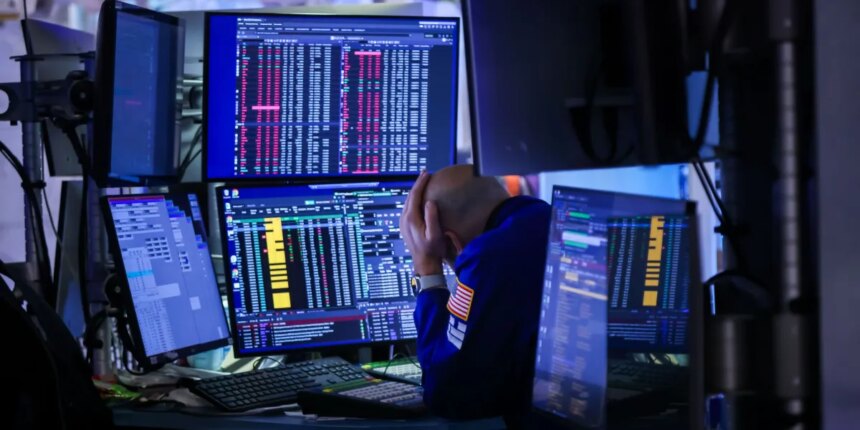
Markets are currently experiencing significant turbulence, with major indices taking a hit yesterday. The S&P 500 closed down more than 1%, while the Dow Jones Industrial Average mirrored this decline. The Nasdaq Composite faced a steeper drop, shedding nearly 2%. In contrast, the VIX volatility index surged over 9%, indicating ongoing market volatility.
In a note to clients, Apollo’s chief economist, Torsten Sløk, highlighted the concerning state of market valuations, calling the S&P 500 “historically extreme.” He referenced the “Warren Buffett indicator,” which measures the ratio of U.S. stock market capitalization to GDP, alongside the Shiller cyclically adjusted price-to-earnings ratio. Both indicators are trending toward extreme levels, with 2025 identified as a particularly notable outlier.
Analysts are becoming increasingly apprehensive about a potential market correction. This week, the CEOs of Morgan Stanley and Goldman Sachs warned that a significant selloff could be on the horizon, with projections indicating that markets may adjust downward by as much as 20% over the next two years.
However, UBS’s chief investment officer, Mark Haefele, downplayed the notion that high valuations alone signal an imminent correction. He emphasized that market declines are more likely to occur when corporate profit growth disappoints, suggesting that future market returns are closely linked to changes in earnings expectations for the upcoming year. Haefele noted that the current earnings season has been robust, with earnings beats outpacing historical averages. He forecasted a 10% growth in S&P 500 earnings per share this year and a rise in expectations for 7.5% growth next year, asserting that current valuations are justified due to the significant presence of high-multiple sectors like technology within equity benchmarks.
Amidst these discussions, the driving force behind these valuations appears to be artificial intelligence (AI). The enormous capital expenditure directed toward AI and its infrastructure is not only boosting market valuations but is also a critical component of the U.S. economy. However, questions of a potential bubble loom, raising concerns about whether AI can fulfill its ambitious promises.
Lisa Shalett, chief investment officer at Morgan Stanley, cautioned investors regarding the sustainability of the AI boom, noting that portfolio positioning is contingent on whether the anticipated growth from AI capital expenditures materializes. She characterized the outlook as a “50/50” chance, suggesting that the implementation of AI may take longer than expected, and productivity gains may be limited to a select few leading companies.
JPMorgan’s asset and wealth management CEO, Mary Callahan Erdoes, contributed to the conversation by asserting that many companies have yet to fully realize the benefits of AI. At a recent forum, she remarked that less than 10% of companies currently implement AI technologies in their offerings, pointing to a vast opportunity for growth. She underscored the importance of timing: when companies will begin to deliver the results that their high valuations suggest, highlighting that while current multiples may seem inflated, they are likely to align more accurately with performance over time.
As the market opens in New York this morning, here’s a snapshot of the indices:
– S&P 500 futures are up 0.17% after closing down 1.12% in the last session.
– The STOXX Europe 600 opened flat.
– The U.K.’s FTSE 100 dipped 0.48% in early trading.
– Japan’s Nikkei 225 fell by 1.19%.
– China’s CSI 300 gained 0.31%.
– South Korea’s KOSPI decreased by 1.81%.
– India’s NIFTY 50 saw a slight decline of 0.1%.
– Bitcoin has also seen a downturn, hovering around $100.9K.
The current market landscape indicates a complex interplay of high valuations, economic forecasts, and the transformative potential of technology like AI, leaving investors cautiously monitoring the developments ahead.


