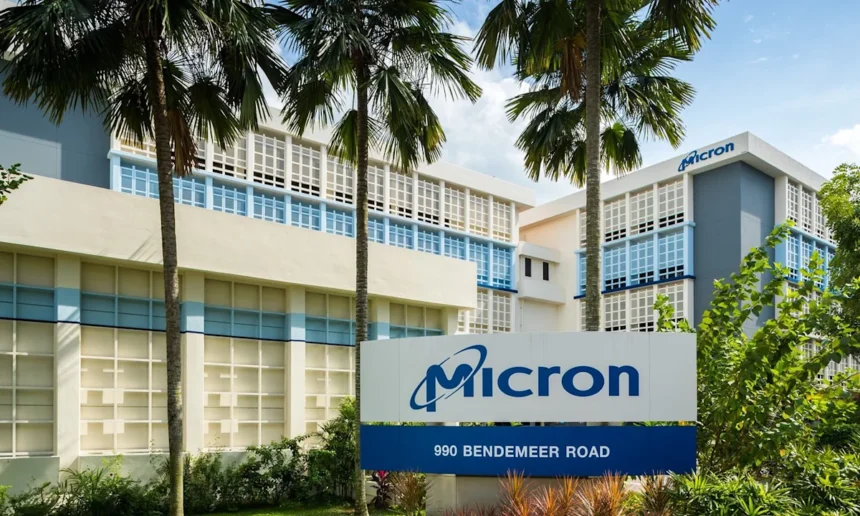
Shares of Micron Technology have surged past the $1,000 mark, catapulting the company into the elite trillion-dollar valuation club. This remarkable surge is indicative of the significant impact artificial intelligence (AI) is having on the semiconductor industry, particularly in the realm of memory chips, which are evolving from generic commodities to essential infrastructure.
As Micron’s stock continues to soar, investors are keenly interested in its future trajectory. A range of factors will influence this, including the sustainability of AI-driven demand in data centers, how Micron’s valuation compares against the historical volatility of the memory sector and current market leaders, and whether the stock price has fully factored in its most optimistic potential.
A pivotal driver behind Micron’s impressive growth is the skyrocketing demand for high-bandwidth memory (HBM) and advanced DRAM solutions. AI applications, which involve extensive training and inference workloads, require substantially larger bandwidth and memory capacity than conventional solutions can offer. HBM, utilized alongside GPU clusters in servers, is essential for the low-latency data transfer necessary for complex models and compute-heavy operations. Micron, along with industry giants Samsung and SK Hynix, is among the largest HBM producers.
Micron’s management has consistently highlighted the striking imbalance between HBM supply and demand. Currently, the company’s entire production capacity for 2026 has already been booked, and predictions indicate that DRAM shortages will persist beyond 2027, as investments in AI continue to grow. According to TrendForce, the global memory market is anticipated to reach a valuation of $1.3 trillion by 2027, marking a 44% increase from 2026. Estimates indicate that DRAM revenue will skyrocket by 303% this year, peaking at $619 billion, and further expanding to $903 billion by 2027.
As HBM and DRAM face ongoing supply constraints, producers like Micron are positioned to maintain significant pricing power, potentially leading to robust gross margins that are rarely seen within the memory market.
The memory market has historically been characterized by its cyclical nature. In past supercycles, Micron’s price-to-earnings (P/E) ratio typically bottomed out between 3.5 and 8, as investors prepared for the inevitable production oversupply following capacity expansions. Currently, Micron exhibits a P/E of 48, significantly higher than its historical lows. This surge reflects that the company’s profitability has escalated rapidly, positioning the P/E ratio as a reflection of markedly increased earnings per share (EPS) rather than mere relative multiple expansion.
What distinguishes the current market scenario is Micron’s ability to secure long-term commitments from customers. The shift from spot-market negotiations to multiyear supply agreements with major hyperscalers helps mitigate the historical boom-and-bust volatility common in the memory sector. Micron’s P/E multiple of 48 now takes into account the projected earnings growth and the revaluation of memory products as integral components in AI infrastructure.
When evaluating Micron against other prominent AI chipmakers like Nvidia, Broadcom, and Taiwan Semiconductor Manufacturing, some valuable insights emerge. These companies have consistently traded at higher valuation multiples during the rise of AI, often exceeding P/E ratios of 40. Despite stock price increases, their forward P/E ratios have settled in the mid-20s to mid-30s range, reflecting strong investor confidence in the sustained demand and pricing power corroborated by heightened hyperscaler investments.
Micron’s trailing P/E ratio fits within the competitive landscape, but its forward P/E ratio of 9.5 is particularly attractive, indicating significant potential for valuation expansion given its projected revenue and earnings growth over the next few years. This contrast suggests that Micron possesses the potential for significant upside before being deemed fully priced.
However, investing in Micron carries inherent risks. Should new capacity from Micron and its competitors become operational sooner than expected, or if hyperscalers begin to temper their capital expenditures for data centers, Micron’s profit margins and valuation metrics may revert towards historical norms.
Despite these risks, the combination of tight HBM supply, long-term contract visibility, and a relatively modest valuation compared to its AI chip counterparts indicates that Micron stock still holds substantial upside potential before reaching levels that might represent an overvaluation.
For those contemplating an investment in Micron Technology, it is important to note that the company’s potential was not included in the latest recommendations from financial analysis platforms, which identified a list of 10 high-potential stocks. Past recommendations from such platforms have yielded impressive returns, prompting investors to weigh their options carefully.
In conclusion, while Micron Technology showcases promising indicators in the high-demand memory segment driven by AI advancements, potential investors should exercise caution and consider broader market factors before making a decision.