As the countdown to the Powerball drawing approaches, anticipation has reached a fever pitch with a staggering jackpot of $1.8 billion at stake. This represents the second-largest Powerball jackpot in history, prompting San Diegans to flock to retailers across the county in hopes of securing a life-changing ticket.
Among those vying for a chance at the massive prize is Eric Williams, who purchased $100 worth of tickets, giving him 50 opportunities to win. Williams shared his philosophy on lottery play, stating, “You gotta pay big to win big,” and if fortune smiles upon him, he plans to opt for the lump sum payment.
Robert Comacho is also in the game, having purchased 10 tickets. He echoed the sentiment of many hopeful players, stating, “We’re trying to buy our fortune here. We’ll see what our luck brings us.” He, too, plans to choose the lump sum option should he strike it rich.
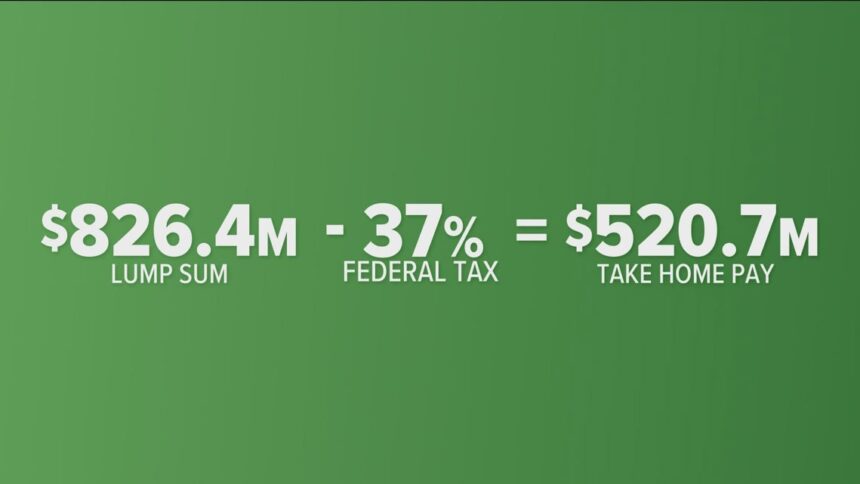
For winners, the choice lies between a series of payments stretched over 30 years or a one-time lump sum. However, both options come with significant federal tax implications. A deep dive into the payout mechanics reveals that the cash value of the $1.8 billion jackpot is approximately $826.4 million. This figure is established by applying a discount formula to the prize pool governed by the Multi-State Lottery Association’s Finance and Audit Committee.
Upon winning, federal tax withholdings immediately take 24% of any winnings over $5,000, resulting in a post-withholding amount of $628 million. Yet, as winners fall into the highest tax bracket, they face an additional levy of 37% in total federal taxes, which amounts to roughly $107 million. Tax law expert Miranda Fleischer, a professor at the University of San Diego, highlighted that “their last dollars, which they’re going to have a lot of those dollars, are taxed at 37% this year.”
When all federal taxes are accounted for, the prize effectively diminishes to around $520.7 million. Adding a silver lining for California winners, the state does not impose taxes on lottery winnings, making it a more favorable locale for jackpot recipients.
Fleischer further explained that the tax burden remains consistent whether winners opt for the lump sum or annuity payments. “Mathematically, they even up due to the time value of money and what you could invest it in,” she clarified.
Despite the considerable tax deductions, William maintains a positive outlook, exclaiming, “If you told me $520 million? That would be good. That would last me a while.” Comacho shared a similar perspective, declaring, “I think we can survive off of that.”
As excitement builds in anticipation of Saturday night’s drawing, it is essential for winning ticket holders to be aware of their responsibilities. In California, winners have a 180-day window to claim their prize after the drawing.
For those eager to catch the drawing or check their numbers, resources are readily available. Meanwhile, CBS 8 continues to prioritize its commitment to the community, encouraging audiences to share their ideas for coverage and assistance.