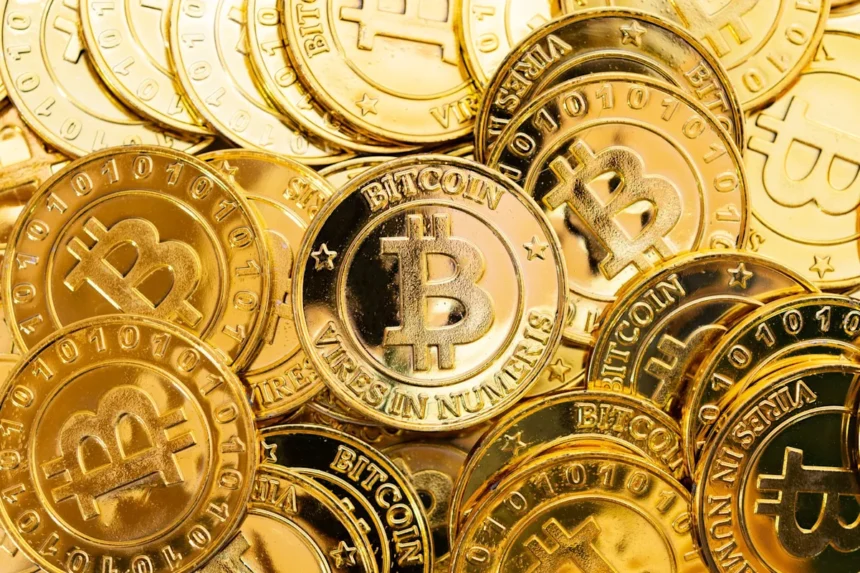
Bitcoin’s recent performance has raised concerns among investors, especially with the cryptocurrency trading at a staggering 51% below its peak value from October of last year, as observed on June 23. Despite the current bear market climate, some analysts maintain an optimistic outlook for Bitcoin’s long-term potential.
Comparative analyses highlight significant disparities between Bitcoin and gold. The market capitalization of all above-ground gold resources is estimated at $28.9 trillion—more than 22 times that of Bitcoin’s $1.3 trillion. However, optimism persists that Bitcoin will eventually close this gap.
Several arguments support the belief that Bitcoin could surpass gold in value within the next 20 years. One key advantage is the financial infrastructure that supports Bitcoin transactions. Unlike gold, Bitcoin transactions can be easily made and verified at the point of sale, allowing for faster and more efficient commerce.
Furthermore, Bitcoin’s portability is unparalleled; individuals can memorize a recovery phrase of just 12 or 24 words to access their digital holdings, making it incredibly easy to transport. Gold, in contrast, is hefty and cumbersome to move over long distances. Additionally, Bitcoin’s divisibility is superior, as it can be divided into 100 million satoshis, while gold can only be physically altered through melting and remolding.
Scarcity is another pivotal point where Bitcoin shines. The cryptocurrency is capped at 21 million units, a limit enforced by its underlying technology and periodic halving events. In contrast, the supply of gold is continually expanding; estimates suggest a 1.75% increase in 2024, compared to Bitcoin’s inflation rate of 1.1%.
Despite these advantages, gold has a long-established reputation as a store of value, having been used for thousands of years. This historical context gives gold a certain longevity that Bitcoin, less than 20 years old, still seeks to develop.
As economies evolve toward greater digital integration, Bitcoin’s nature as a purely digital asset positions it favorably. The rise of the internet and the anticipated growth of artificial intelligence suggest that digital currencies may increasingly supplant traditional forms of value. Should artificial intelligence and autonomous agents become active economic participants, they may gravitate toward a neutral, transparent, and scarce currency like Bitcoin.
Investors considering Bitcoin should weigh their options carefully. While some financial advisors recommend stocks with strong growth potential, Bitcoin was notably absent from a recent list of the top ten stocks compiled by experts at The Motley Fool. Their historical performance shows remarkable returns from select stocks, suggesting alternative investment routes.
In summary, while Bitcoin currently faces significant challenges in the bear market, the potential for long-term growth remains. Its digital superiority, portability, and scarcity put it in a unique position to potentially outshine gold in the coming decades. Investors are encouraged to conduct thorough research and consider the shifting dynamics of the global economy when making their decisions.