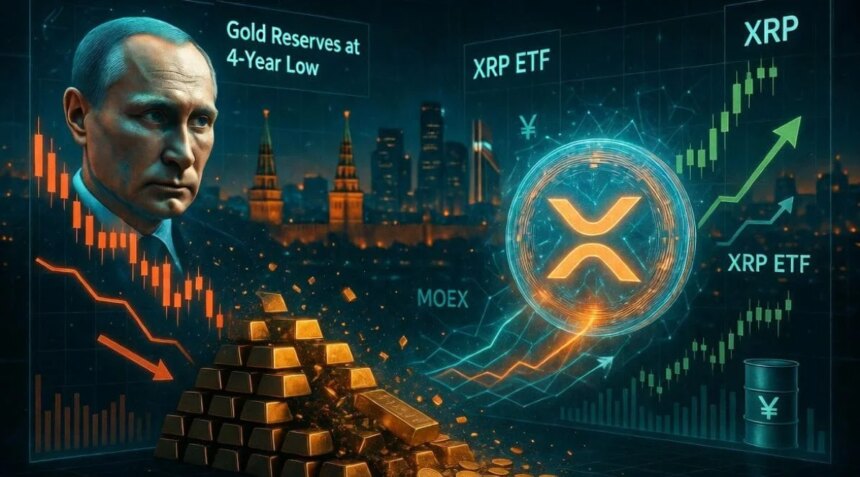
Russia has been strategically amassing one of the world’s largest sovereign gold reserves since 2007, a move aimed at creating a financial buffer against international sanctions. By mandating that domestic gold producers sell directly to the Central Bank, Moscow built up its bullion stockpile as an asset that remains unaffected by Western banking systems and dollar clearing restrictions. As the Ukraine conflict escalated in early 2022, these reserves reached peak levels; however, recent developments indicate a significant shift.
As of the first four months of 2026, the Bank of Russia has slashed its gold holdings by nearly 900,000 ounces, bringing the total down to approximately 73.8 million ounces, the lowest since early in the war. Experts at BNE IntelliNews speculate that Russia may sell up to $15 billion worth of gold throughout 2026, following an estimated $30 billion in sales during 2025. This trend represents one of the largest sustained disposals of sovereign gold by a major nation in contemporary history. Economists warn that this depletion of reserves under sanctions could constrain Russia’s capacity to weather future economic shocks.
In a simultaneous move towards digital finance, the Moscow Exchange (MOEX) launched XRP futures contracts on May 14, 2026, shortly after introducing new cryptocurrency indices. This initiative allows Russian investors to gain exposure to leading cryptocurrencies without relying on foreign exchanges and associated risks. Maria Patrikeeva, Managing Director of the Derivatives Market at MOEX, highlighted growing interest, noting that over 62,000 clients had engaged in trading crypto contracts prior to the introduction of XRP.
As XRP gains traction as a potential institutional asset, the underlying architecture enables rapid transactions that sidestep traditional banking systems, including SWIFT. Crypto-facilitated trade from Russia reached approximately 1 trillion rubles (about $11 billion) in 2025, indicating a growing reliance on digital assets for international trade, particularly with China and India.
A critical aspect of this evolving financial landscape is how Russia settles oil payments with its key trading partners. Although Russian banks held substantial amounts of yuan—a total of $68.7 billion in 2023—and trades with China slipped slightly, the shift towards cryptocurrency offers a channel that avoids vulnerabilities associated with dollar dependency.
Additionally, new regulations set to take effect on July 1, 2026, will create a regulated environment for cryptocurrency transactions within Russia. Under these new rules, individuals can buy and sell digital currencies through licensed brokers and exchanges, setting limits on non-qualified investors while providing greater access to qualified ones. Although crypto payments for local goods will remain prohibited, foreign trade settlements will explicitly incorporate digital assets.
While Russia is not outright replacing gold with crypto assets like XRP, the nation appears to be liquidating gold reserves to manage financial constraints imposed by international sanctions. At the same time, it is laying the groundwork for a regulated digital asset ecosystem with XRP positioned at the heart of its international financial strategy.