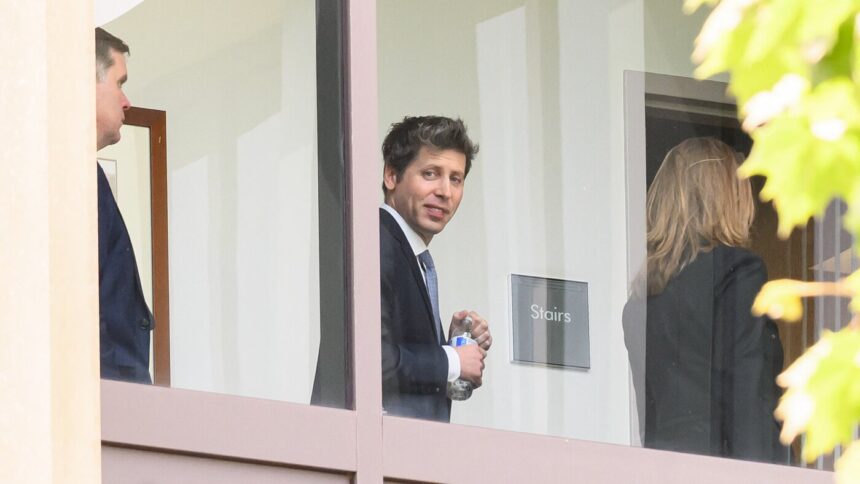
In a courtroom drama unfolding in Oakland, California, OpenAI CEO Sam Altman took the stand to address allegations from co-founder Elon Musk, who accused him of “stealing a charity” by transforming OpenAI from a nonprofit venture into a profitable enterprise. This lawsuit has evolved into a significant confrontation between two of technology’s most influential figures, with the potential to reshape the landscape of artificial intelligence development.
Musk’s legal team argues that Altman and OpenAI President Greg Brockman, aided by substantial investments from Microsoft, abandoned OpenAI’s foundational mission—to develop advanced AI for the benefit of humanity. The plaintiffs assert that the conversion of OpenAI into a for-profit subsidiary led to personal enrichment for its leaders while sidelining original nonprofit goals.
In his testimony, Altman pushed back against Musk’s assertions, suggesting that Musk’s actions stem from anger rather than genuine concern for the organization. He recounted how Musk had attempted to undermine OpenAI by launching his competing company, xAI, and allegedly tried to lure talent away from OpenAI. Altman accused Musk of engaging in “business interference,” which further complicates their contentious relationship.
The roots of this dispute date back nearly a decade when the founders of OpenAI, including Musk, recognized that establishing a for-profit entity was essential for attracting top-tier talent and securing the substantial funding necessary to advance their AI goals. Although Musk initially contributed $38 million to the nonprofit, he sought control over the for-profit branch, a move met with resistance from other co-founders. Altman emphasized on the stand that Musk was viewed as unsuitable for leading efforts in artificial general intelligence (AGI), prompting his departure from the board in 2018—a shift Altman claims unexpectedly boosted employee morale.
The trial has provided an unusual glimpse into the heated discussions among Silicon Valley’s elite regarding the future of AI technology and the frameworks for investment and company leadership. OpenAI ultimately established itself as a leader in the field with the successful launch of ChatGPT in 2022.
In an effort to establish Musk’s credibility as questionable, OpenAI’s attorneys presented previously private messages and emails suggesting Musk’s initial support for the for-profit initiative was driven by desires for investment returns. They also highlighted attempts by Musk to recruit former OpenAI talent while allegedly maintaining influence over company decisions through Shivon Zilis, a key board member and mother of several of Musk’s children.
Conversely, Musk’s attorneys focus on portraying Altman and Brockman as focused primarily on their financial interests, contrary to the original mission of the organization. They argue that while OpenAI’s nonprofit still exists and technically owns the now-highly-valued for-profit entity, it has effectively been rendered irrelevant.
During cross-examination, Altman faced challenging questions about his reliability. He admitted he has occasionally been called less than truthful but maintained his overall trustworthiness. If the court sides with Musk, it could lead to the imposition of significant financial penalties—up to $150 billion—and the potential dismantling of the for-profit structure. The outcome could have profound implications for OpenAI’s leadership and its ability to innovate in AI technology.
Closing arguments are scheduled for Thursday, with a decision from the advisory jury and the presiding judge, Yvonne Gonzalez Rogers, expected as early as next week.