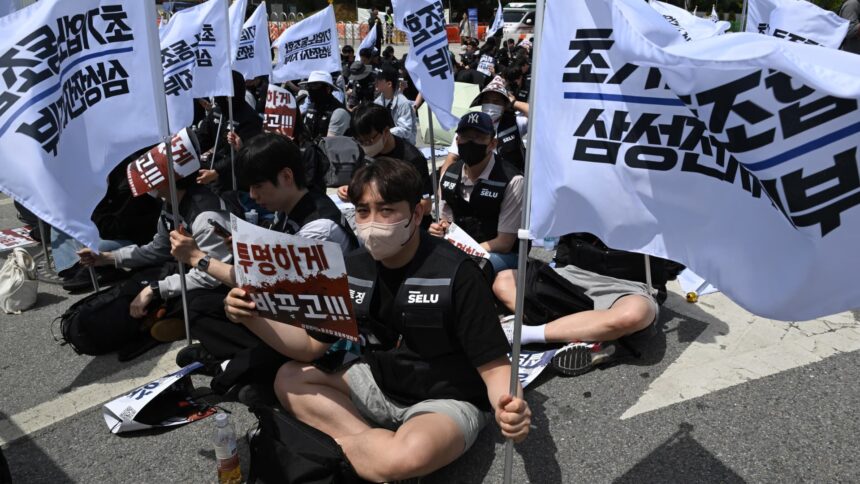
Members of the Samsung Electronics labor union gathered in Pyeongtaek on April 23, 2026, to hold a mass rally demanding the removal of a cap on performance bonuses. This demonstration came amid escalating tensions between the union and the company following the announcement of a planned 18-day strike. The strike was initially set to proceed after government-mediated negotiations broke down. However, a subsequent round of discussions led by the South Korean Minister of Labor and Employment, Kim Young-hoon, resulted in a tentative agreement that suspended the strike.
In the aftermath of the labor union’s decision, shares of Samsung Electronics surged more than 6%, alleviating concerns around potential disruptions in operations at one of the world’s leading semiconductor manufacturers. The anticipated strike had raised alarm bells throughout the industry, but the announcement of the tentative agreement shifted market sentiment favorably.
During a briefing broadcasted by government outlets, Minister Kim addressed the provisional nature of the agreement, acknowledging that while substantial progress had been made, several issues still required resolution. He noted, “The gap between the two sides has narrowed considerably,” while highlighting that the union had made significant concessions to facilitate the negotiations.
Media reports indicated that Samsung’s lucrative chip division would receive 40% of the total bonus pool, with the remainder allocated to other business units. A contentious decision regarding the distribution of bonuses among Samsung’s less profitable divisions was postponed for a year. Additionally, it was reported that Samsung would provide a special bonus equivalent to 10.5% of operating profits to its chip division. This marked a shift towards a system where bonuses would be tied to operating profits, and the previous cap on bonuses would be abolished.
New arrangements would also include partial funding for these special bonuses through company stock over a period of at least a decade, contingent on the chip division hitting demanding operating profit targets. The targets were set at 200 trillion won ($133.65 billion) for the years 2026 to 2028, with a reduced goal of 100 trillion won for the subsequent years.
The labor union had initially sought performance bonuses amounting to 15% of Samsung’s operating profits, along with the complete removal of bonus caps and a formalized structure for bonus distribution. This approach is reminiscent of recent agreements in the sector, such as one made by rival SK Hynix, which set aside 10% of operating profits as bonuses for its workforce.
The stakes of the negotiations were underscored by comments from South Korean President Lee Jae Myung, who remarked that while labor unions should have the right to negotiate for their interests, there must be reasonable limits in doing so. The nation’s Prime Minister, Kim Min-seok, had estimated that losses from the potential strike could amount to 1 trillion won, while total economic repercussions could soar to 100 trillion won if production disruptions led to scrapping semiconductor wafers already in progress.
Samsung Electronics stands as a vital pillar of the South Korean economy, accounting for nearly 23% of exports and 26% of the country’s total market capitalization. Its revenues contribute significantly to the national GDP, further emphasizing the critical nature of the ongoing labor negotiations and their potential implications for the broader industry.