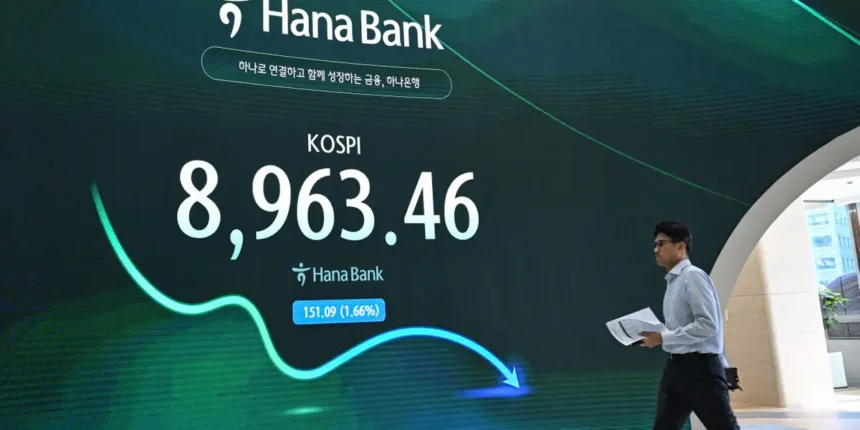
South Korea’s stock market experienced a significant decline on Tuesday, closing nearly 10% lower as investors reacted to a global tech selloff that disproportionately affected artificial intelligence (AI)-related stocks. The benchmark Kospi index plummeted 9.99%, marking its steepest drop since early March and triggering a market circuit breaker in response to the rapid loss of value.
This downturn follows a rocky day on Wall Street. The Nasdaq Composite, known for its tech-heavy composition, fell by 1.3% on Monday, predominantly due to losses among major technology firms. Conversely, the Dow Jones Industrial Average showed a slight increase of 0.3% during the same session. Market participants were also focusing on rising U.S. Treasury yields and geopolitical tensions stemming from the ongoing conflict in Iran, further complicating the investment landscape.
Chris Weston, head of research at Pepperstone, commented on the shifting market dynamics, noting that former “market generals” have seemingly lost momentum. He observed a rotation among investors towards more defensive sectors that offer stable cash flows, distancing themselves from the high volatility typically associated with AI stocks.
South Korea’s equity market, which has seen robust performance this year largely driven by a surge in AI-related investments, is now grappling with the repercussions of this pullback. Notably, major chipmakers were among the hardest hit during Tuesday’s selloff. Samsung Electronics saw a staggering decline of 12.3%, while SK Hynix fell by 12.5%. Both companies had recently achieved the significant milestone of entering the $1 trillion market capitalization club.
The negative sentiment rippled across Asia, with Japan’s Nikkei 225 closing down 3.6% and Hong Kong’s Hang Seng Index dropping more than 2%. Chinese stock benchmarks also recorded losses as the investor mood remained pessimistic.
As the day progressed, U.S. stock futures indicated a continuation of this bearish trend, with S&P 500 futures down 1.3%, Dow futures falling by 0.5%, and Nasdaq futures showing a considerable decrease of 2.2%. Investors are closely monitoring these developments as the market seeks to stabilize amid heightened volatility and shifting economic indicators.