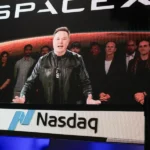
The recent debut of SpaceX on the stock market has marked a historic moment, generating a substantial financial windfall for major Wall Street banks involved in the initial public offering (IPO). The rocket manufacturer raised a staggering $75 billion, leading to anticipated underwriting fees of $500 million, which constitutes approximately 0.7% of the total raised, according to regulatory filings.
Goldman Sachs and Morgan Stanley, who spearheaded the monumental offering, are projected to receive $100 million each, equating to a 20% share of the total fees. Meanwhile, Bank of America, Citigroup, and JPMorgan Chase will each earn around $75 million from the transaction.
While the fees are considerable in absolute terms, they are notably modest compared to the customary earnings banks usually extract from significant IPOs. This underscores the willingness of these major financial institutions to maintain strong relationships with SpaceX and its CEO, Elon Musk. Mike Mayo, an equity analyst at Wells Fargo, referred to the deal as a “trophy deal,” emphasizing that the strategic advantages far outweigh the monetary compensation.
Interestingly, JPMorgan’s involvement took a different turn in recent days. Although it did not secure a top underwriting position in SpaceX’s IPO, it notably hosted the listing party for over a hundred SpaceX employees and executives at its skyscraper headquarters in Midtown Manhattan. This event, which included themed cocktails and a visually striking display of a rocket ship affixed to the top of the building, was orchestrated by CEO Jamie Dimon, hinting at a reconciliation between him and Musk after a long history of tensions dating back to 2016.
Their previous disagreements primarily revolved around JPMorgan’s refusal to underwrite Tesla’s leasing agreements. However, the two leaders have reportedly made strides toward amicability, as demonstrated by a recent interview appearance featuring both Dimon and Musk, attended by key clients and Musk’s mother.
The implications of the SpaceX IPO are far-reaching, according to Mayo. He noted a “multiplier effect” that could enhance SpaceX’s appeal for future fundraising efforts and facilitate engagement with the company’s new cohort of millionaires and billionaires.
Additionally, the $75 billion offering aligns with an evolving trend in capital markets, which Mayo describes as an AI-driven “supercycle.” For Goldman Sachs and Morgan Stanley, this IPO is particularly critical, as it positions them well ahead of upcoming equity listings from AI firms like Anthropic and OpenAI, both of which are highly anticipated later this year.
Goldman Sachs COO John Waldron expressed optimism about the wave of IPO activity hinted at by the SpaceX offering, indicating a continued investor appetite for companies with significant AI aspirations. The successful launch of SpaceX’s IPO is poised to set the stage for a new era in the market, highlighting investors’ readiness to engage with ambitious technology ventures.