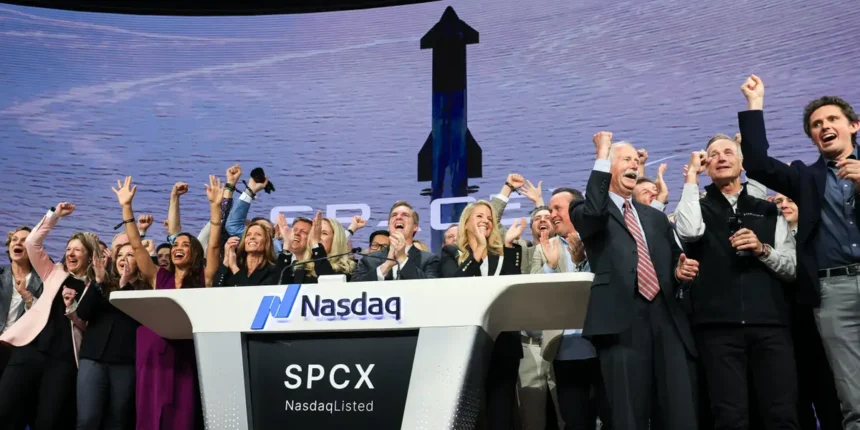
Shares of SpaceX experienced a significant decline, marking a downward trend following the company’s record-breaking initial public offering (IPO) earlier this month. On Monday, the stock dropped nearly 17% to $154.60, extending a three-day losing streak that has seen the shares plummet by 27% since reaching a closing price of $211.39 on June 16.
This downturn comes after a remarkable surge only a week earlier, when SpaceX’s valuation briefly soared close to $3 trillion, allowing it to surpass tech giants like Amazon and Microsoft and secure its position as the fourth-most valuable company globally. As of Thursday’s close, SpaceX’s market capitalization settled at approximately $2.4 trillion.
The public debut of SpaceX on June 12 marked the largest IPO in history, with shares soaring 19% on their first day of trading. This milestone not only solidified Elon Musk’s status as the world’s first trillionaire but also attracted a wave of retail investors eager to capitalize on the company’s ventures in rocketry, artificial intelligence, and satellite technology. Even amid the recent downturn, SpaceX shares remain up nearly 30% from their original IPO price.
Despite this positive trajectory from the IPO, analysts have raised concerns regarding the company’s lofty valuation, estimated at around $1.75 trillion to $1.77 trillion. The doubts have intensified in light of the company’s reported $4.9 billion loss in 2025, contrasted with revenues amounting to $18.7 billion.
To bolster its ambitious plans, which include putting humans on Mars, SpaceX raised $85.7 billion in its IPO. However, the company is still seeking additional funds, as evidenced by a Monday filing indicating it is pursuing cash through bond sales to repay an existing bridge loan. As of June 19, SpaceX reported holding approximately $100.8 billion in cash and cash equivalents, positioning it for the financial demands of its future projects.