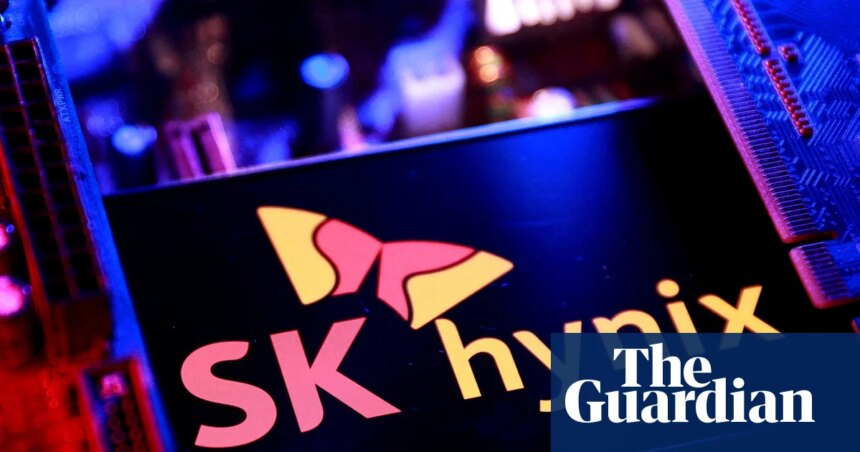
Shares in chipmakers have experienced a remarkable surge in the first half of the year, driven by heightened investor interest in companies at the forefront of the artificial intelligence boom. This trend has come at the expense of some large software firms, which have seen their stock prices decline as attention shifts towards hardware manufacturers.
According to recent analysis, semiconductor and memory chip companies have witnessed substantial profits in 2026, with many experiencing share price increases of threefold or more since January. The soaring performance of these firms has notably boosted stock markets across the Asia Pacific region. South Korea’s Kospi index has surged by 125% this year, marking its strongest first half since at least 1990. Key contributors to this rise include Samsung, whose stock has jumped by 183%, and SK Hynix, which has seen an incredible 310% increase, as demand for chips from AI companies intensifies.
In the United States, chipmakers have also gained significant traction. Companies such as Sandisk have reported staggering increases of 780% in 2026, and an astronomical 4,510% over the past year. Other notable performers include Western Digital, whose stock has risen by 240%, Micron at 296%, and Seagate with a 226% uptick, all within days of the new quarter commencing. These impressive gains have been characterized as something investors might typically expect only over decades.
Dan Coatsworth, head of markets at the investment platform AJ Bell, emphasized that the combination of demand outstripping supply has led to a surge in memory chip prices, driving impressive earnings growth for suppliers. This surge has not gone unnoticed in the broader market; recently, Apple cited rising memory chip costs as a contributing factor to price increases for its iPad and MacBook products.
However, not all sectors are benefiting from this chip boom. Shares in “hyperscalers” — large tech firms rolling out AI services — have declined in recent weeks. Microsoft, for example, has seen its stock dip by 24% during 2026, reaching a one-year low. Investors have expressed concern over the extensive spending plans announced by major AI companies, which are expected to strain cash flow and increase capital intensity.
Despite a generally successful stock market performance in 2026, there are indications that the enthusiasm for chip stocks may be waning. Recent trends suggest a rotation of investment from tech toward other sectors, with analysts noting a desire among investors to secure profits amid fluctuating market conditions.
Additionally, the stock markets have had solid gains overall this year. The Nikkei in Japan has climbed 38%, while the UK’s FTSE 100 has seen a growth of 5.8%, despite previous market pressures related to geopolitical tensions. Brent crude oil prices began the year around $60 a barrel and are now approximately $12 higher, having previously spiked due to supply concerns.
Looking ahead, Mark Haefele, chief investment officer at UBS Global Wealth Management, forecasts continued growth for the US market, projecting an increase in the S&P 500 to 8,200 points by June 2027. He attributes this optimism to ongoing strength in AI capital expenditure, a resilient US economy, and robust global fiscal spending, all contributing positive momentum for corporate earnings and broader market stability.