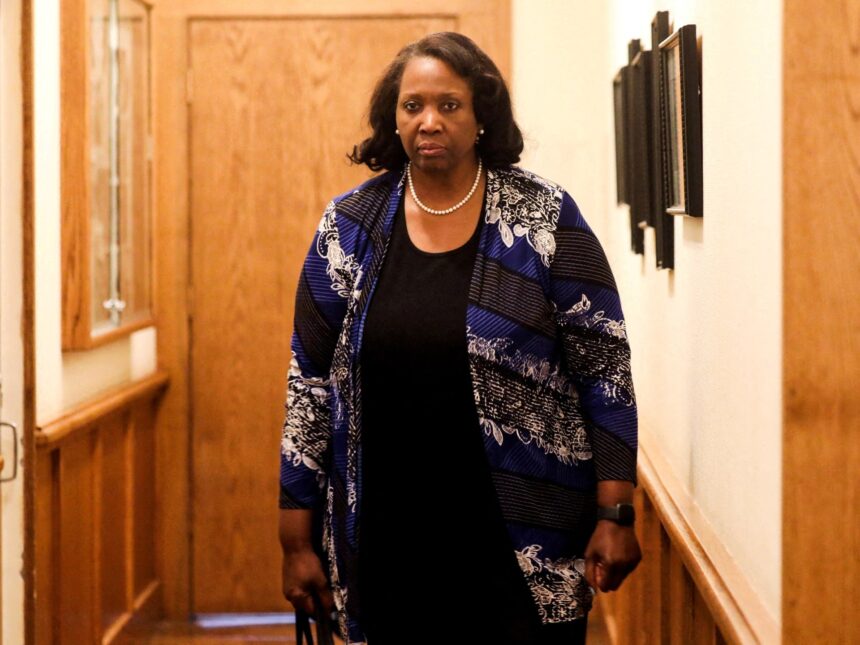
The administration of former President Donald Trump is actively pursuing the removal of Lisa Cook from her position on the Federal Reserve’s board of governors, following a federal court ruling earlier this week that blocked her dismissal while her legal challenge is underway. This request, made to the U.S. Court of Appeals for the DC Circuit, comes just days before the Fed’s upcoming interest rate-setting committee meeting scheduled for next week.
On Thursday, the Department of Justice filed an emergency appeal to pause a ruling from U.S. District Judge Jia Cobb, which temporarily prevents Cook’s removal. Judge Cobb’s decision came after Cook filed a lawsuit against Trump, asserting that he lacked the legal grounds to terminate her because the allegations surrounding her involvement in mortgage fraud occurred before she assumed her role at the Fed. Cook contends that these claims are merely a pretext for her dismissal, motivated by her monetary policy decisions.
The urgency of the administration’s request underscores its desire to influence the Federal Reserve’s composition before the central bank discusses interest rates. Concurrently, Republican senators are working to expedite the confirmation of Stephen Miran, another Trump nominee for the Fed, which could occur as early as Monday.
In their court filing, Trump’s legal team argued that even if the alleged misconduct transpired before Cook took office as a governor, it raises significant concerns about her trustworthiness. They requested that the appeals court render a decision by Monday, which would allow Cook to be removed temporarily from her position as the legal proceedings unfold. Should the appeals court side with Cook, the administration may consider seeking an expedited ruling from the Supreme Court.
The implications of this case extend beyond Cook’s individual circumstances. It touches on the critical principle of the Federal Reserve’s independence—a cornerstone for effective monetary policy that shields the institution from political interferences. The law governing the Federal Reserve specifies that governors can only be removed “for cause,” although the lack of a clear definition or established removal procedures has yet to be judicially tested.
Judge Cobb emphasized the importance of preserving the Fed’s independence while her ruling noted that her best interpretation of the law suggests that only misconduct occurring during a Fed governor’s tenure can justify removal from office. The allegations against Cook, which relate to her actions before her Senate confirmation in 2022, could set a significant precedent regarding the power of the presidency over independent agencies like the Fed.
Trump has been vocally critical of Federal Reserve Chair Jerome Powell, pressuring the bank to adopt more aggressive rate cuts. Cook has consistently voted with the majority on the Fed for all rate decisions since her appointment, making her continued presence on the board particularly pivotal in the current monetary policy climate.
Compounding this legal battle, the Justice Department is reportedly conducting a criminal investigation into Cook related to the mortgage fraud allegations, having issued grand jury subpoenas in Georgia and Michigan. As this situation unfolds, it raises fundamental questions about the balance of power between the presidency and independent financial institutions in the United States.