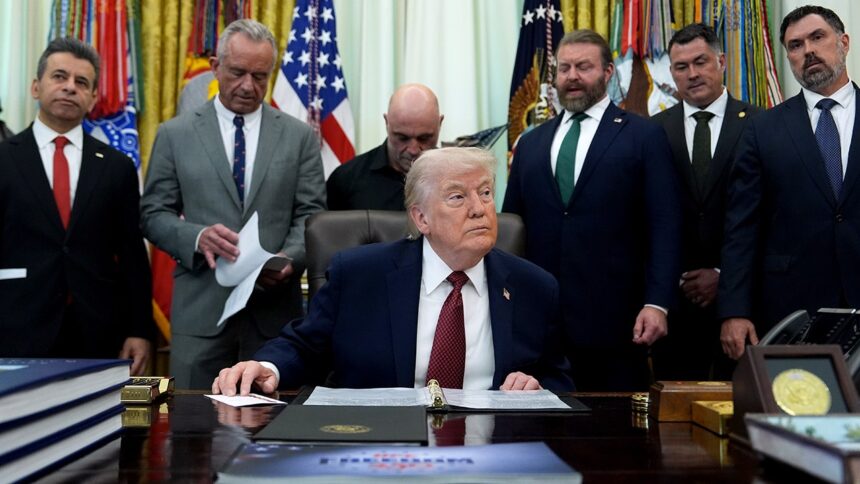
President Donald Trump has taken a significant step in shaping the future of mental health treatment by signing an executive order aimed at expediting the Food and Drug Administration’s (FDA) review process of certain psychedelics designated as breakthrough therapy drugs. This landmark decision was announced during a public event where Trump emphasized the potential benefits of these treatments for veterans and individuals suffering from severe mental illness.
During the signing on Saturday, Trump described the executive order as a pivotal moment, stating, “These treatments are currently in the advanced stages of clinical trials to ensure that they’re both safe and effective for American patients.” He underscored that the reforms outlined in the order will dramatically enhance access to medical research and treatments involving psychedelic substances.
Trump highlighted the pressing need for such initiatives, particularly in light of alarming statistics regarding veteran mental health. He noted that many experimental treatments have exhibited life-changing potential for those grappling with severe mental health issues, and mentioned the high rates of suicide among veterans as a particular concern.
The order aims to dismantle bureaucratic barriers that have historically impeded progress in this field. According to Trump, the executive measure will facilitate better data-sharing between the FDA and the Department of Veterans Affairs and also speed up the rescheduling process for any psychedelic drug that receives FDA approval. “Usually with things like this, nothing ever happens, regardless of how the research ends up,” he remarked, expressing a commitment to change that narrative.
Citing promising results from a Stanford University study, Trump referenced a trial involving 30 special operation veterans who underwent ibogaine treatment, with participants reporting an impressive 80-90% reduction in symptoms of depression and anxiety within a month. Furthermore, he revealed that both Texas Republican leaders and the federal government are committing significant funds—$50 million from Texas and an equivalent amount from the federal budget—toward ibogaine research.
Additionally, the executive order opens a pathway for ibogaine to be used under the Right to Try law, which allows severely ill patients to access experimental therapies. Trump expressed hope that this initiative would give those with debilitating symptoms a chance to reclaim their lives.
The potential of ibogaine as a treatment option has been documented in academic literature as well. According to a paper published in the journal Chronic Stress, ibogaine is a psychoactive compound derived from the Tabernanthe iboga shrub, historically used in various cultural rituals. Research has suggested its ability to alleviate mood and anxiety symptoms, particularly in individuals dealing with substance-use disorders, by enabling therapeutic interactions with traumatic memories.
Health and Human Services Secretary Robert F. Kennedy Jr. reinforced the significance of these developments, framing the executive order as a crucial step in addressing the mental health crisis facing the nation. He pointed out that over 14 million Americans live with serious mental illness, with suicide rates rising markedly over the past two decades. The impact is particularly acute among veterans, with thousands lost to suicide each year.
During the event, prominent podcaster Joe Rogan shared his personal experiences related to the movement, stating his motivations stemmed from conversations with key advocates for ibogaine treatment. “They told me how impactful this medicine is,” he said, highlighting the importance of raising awareness about alternative treatments and their potential to transform lives.
This executive order signals a shift in how the U.S. approaches psychedelic therapy, reflecting a growing recognition of its potential benefits in treating a range of mental health conditions.