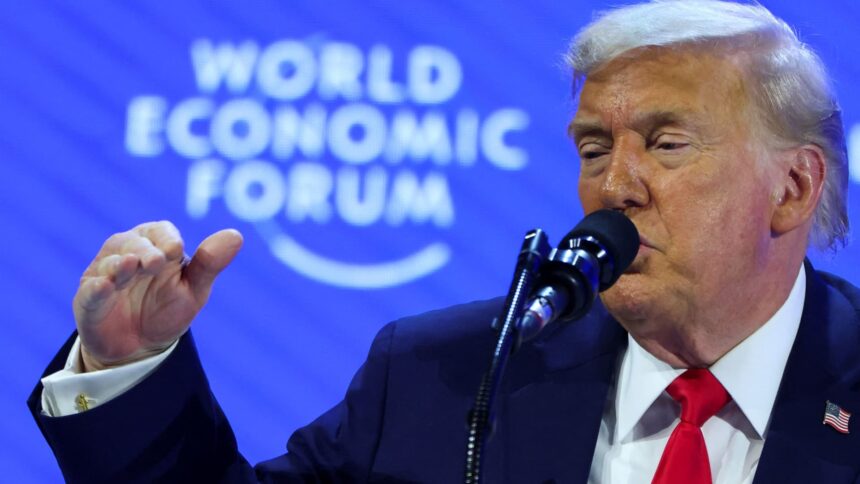
President Donald Trump has called on U.S. lawmakers to enact legislation capping credit card interest rates at 10% for a year, asserting that this measure would assist millions of Americans in saving for homeownership. Speaking from the World Economic Forum in Davos, Switzerland, Trump highlighted the excessively high rates charged by credit card companies, which he noted often exceed 28%.
His comments have stirred interest within the financial sector, leading to a rise in bank shares, with the KBW Bank index increasing by 2.2% during morning trading. Companies like Capital One, which generates a significant portion of its revenue from credit cards, saw a 1.9% gain.
Despite the proposed legislation, analysts remain skeptical about its feasibility. A similar bill, introduced last year by Senators Josh Hawley and Bernie Sanders, sought to impose a 10% cap on card annual percentage rates (APRs) for five years, but has since stalled in Congress. Concerns about bipartisan support are prevalent, especially among Republican leaders such as House Speaker Mike Johnson, who have expressed reservations about the implications of price controls on the credit card market.
Sanjay Sakhrani, an analyst at KBW, remarked on the low likelihood of the card cap being implemented, noting that the policy could adversely impact other sectors, such as airline and retail industries. He suggested that much of the Republican leadership opposes such measures, viewing them as potentially damaging to the economy.
The recent efforts by Trump to pressure banks into lowering their rates, including a post on Truth Social, reflect the challenges of getting financial entities to willingly forgo substantial revenue. Following Trump’s comments, banking executives cautioned that strict rate caps might lead to unintended consequences, such as banks closing accounts for customers with lower credit scores.
Despite Trump’s assertion that lenders failing to comply with the proposed rate cap would be “in violation of the law,” industry representatives counter that current practices are compliant with existing regulations. Many major credit card companies have indicated no immediate changes to their interest rates in response to the president’s call.
Adding to the debate, JPMorgan Chase CEO Jamie Dimon suggested at the Davos forum that the government might consider testing the proposed cap in only two states, Vermont and Massachusetts. He warned that broader implementation could lead to a sharp decline in credit availability, which would disproportionately affect 80% of American consumers.
As discussions on this topic progress, the complexities of the financial sector and legislative hurdles may continue to impede any significant reforms in credit card interest rate policies.