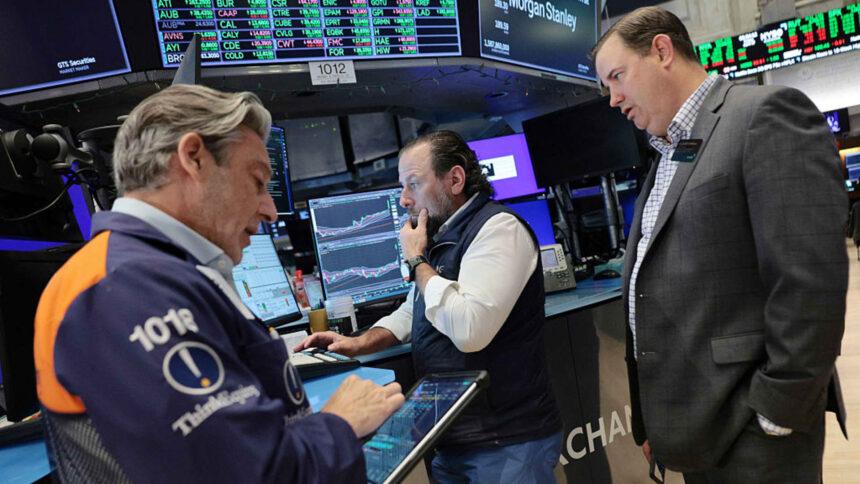
Traders on the New York Stock Exchange faced a challenging start to the week as stock futures plummeted on Sunday night amid escalating tensions between the U.S. and Iran. The Dow Jones Industrial Average futures dropped 425 points, or 0.9%, while the S&P 500 and Nasdaq-100 futures also saw significant declines.
The downturn follows a weekend announcement by President Donald Trump, who stated that the U.S. had fired on and seized an Iranian-flagged cargo ship in the Gulf of Oman. This operation came after Iran opted out of a new round of peace talks scheduled to take place in Pakistan, aimed at resolving the ongoing conflict between the two nations.
In a post on Truth Social, Trump emphasized that the seized Iranian vessel was under U.S. Treasury sanctions due to a history of illegal activity, adding, “We have full custody of the ship, and are seeing what’s on board.” The president also issued a stark warning, threatening to destroy all power plants and bridges in Iran if the country did not agree to terms set by the U.S. A ceasefire currently in place between the two countries is set to expire this week, raising concerns over further military or economic repercussions.
The developments have had immediate impacts on the oil market as well, with crude prices jumping sharply during early trading. West Texas Intermediate futures spiked by 7% to reach $90.33 per barrel, while International Brent gained a similar 7%, climbing to $96.88.
Wall Street had closed positively the previous week, with the S&P 500 and Nasdaq Composite both achieving record highs following a temporary ceasefire between Iran and Lebanon. At that time, Iran announced the reopening of the Strait of Hormuz, a crucial passage for global oil trade. However, as of Saturday, reports indicated restrictions on vessel traffic through the strait, with Iranian state media accusing the U.S. of not fulfilling its obligations under the ceasefire.
Trump has reiterated that the U.S. blockade of the strait would stay in effect until Iran met American demands, contributing to heightened market volatility. Despite the current instability, the S&P 500 had gained 4.5% the prior week, with the Nasdaq Composite increasing by 7.2%. Notably, the Nasdaq marked its 13th consecutive winning session, a feat not seen since 1992. Investors are keen on additional corporate earnings reports set to be released this week, including those from industry giants such as Tesla, Boeing, and Intel.