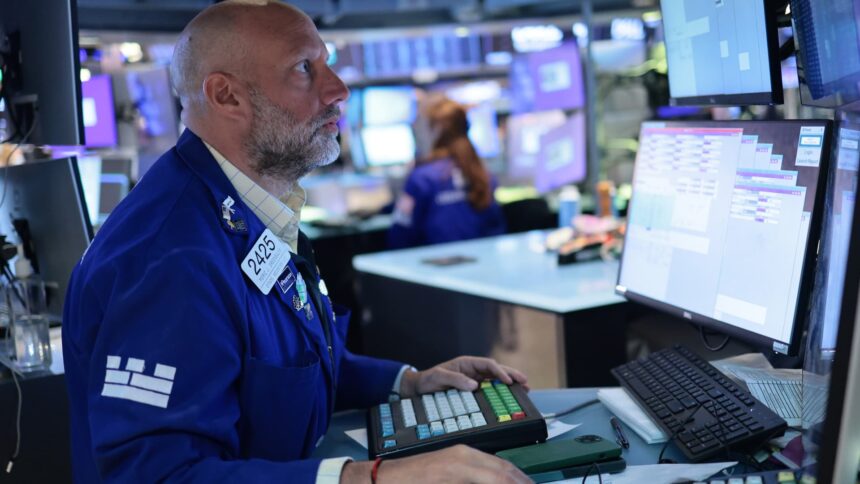
Traders on the floor of the New York Stock Exchange found themselves navigating a complex landscape as tensions between Iran and the U.S. escalated once again. This renewed conflict, following recent attacks in the Middle East, has raised concerns about an extended war, casting uncertainty over the markets.
Futures for the Dow Jones Industrial Average climbed by 124 points, translating to a 0.2% gain. The S&P 500 and Nasdaq-100 also recorded slight increases, rising by 0.4% and 0.5%, respectively. The positive movement in futures reflected investor responses amid the backdrop of geopolitical strife, particularly as the U.S. retaliated against Iranian military targets after strikes near the strategic Strait of Hormuz. President Donald Trump amplified the rhetoric, threatening to “annihilate” Iran in a Truth Social post, where he detailed the U.S. military actions against Iranian missile, drone storage facilities, and coastal radar sites, citing violations of an existing cease-fire agreement.
Negotiations aimed at resolving the ongoing conflict appear to be stalled, according to a Pakistani source involved in talks, although there is a commitment from all parties to keep representatives in Switzerland ready for when discussions can resume. As the potential for further disruptions in the energy markets looms, crude oil prices have risen in early trading, with International Brent oil reaching $72.57 per barrel, a 0.8% increase, while West Texas Intermediate futures saw a 1.1% rise to $70.
Wall Street is coming off a mixed performance from the previous week, characterized by a noticeable shift away from technology stocks. The S&P 500 and Nasdaq Composite both suffered declines—approximately 2% and 4.6%, respectively. Major tech players like Nvidia and Alphabet plunged over 8%, while other significant companies such as Meta Platforms, Apple, and Amazon experienced declines exceeding 4%. SpaceX’s stock took a particularly sharp hit, falling 17%.
In contrast, the Dow, which traditionally has less exposure to technology, saw a gain of 0.6%, buoyed by strong performances from Merck and Johnson & Johnson, which surged by 13% and 11.5%, respectively. This divergence in performance has led to analysts like Ed Yardeni from Yardeni Research describing a sentiment of “AI Fatigue” among investors. Concerns are growing about whether massive investments in AI infrastructure by major companies will yield returns, raising fears of potential obsolescence in technology through what Yardeni terms “creative destruction.”
As the month of June draws to a close, the overall performance thus far shows that the S&P 500 is down about 3%, with the Nasdaq facing an even steeper decline of over 6%. Meanwhile, the Dow has posted a modest gain of more than 1%, highlighting the contrasting fortunes of different sectors in the face of fluctuating market conditions.