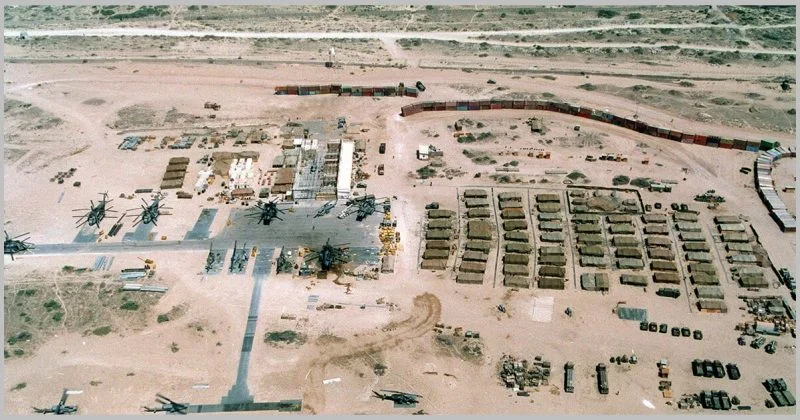
On June 28, Iran’s Islamic Revolutionary Guard Corps (IRGC) escalated tensions in the region by launching missile and drone strikes targeting U.S. military installations in Kuwait and Bahrain. This marked a significant development in an ongoing conflict that has been escalating since early 2026. According to the IRGC, eight sites were hit, including the Ali Al-Salem Air Base in Kuwait and the U.S. 5th Fleet base in Bahrain. Kuwaiti and Bahraini defense forces successfully intercepted most of the incoming projectiles, resulting in no reported U.S. casualties and limited damage.
The strikes were executed using a mix of ballistic missiles and drones. The IRGC described the offensive as a retaliation for prior U.S. airstrikes on Iranian targets, contributing to a continuing cycle of tit-for-tat attacks that has characterized the conflict since February. Both Kuwait and Bahrain are vital to U.S. military operations in the Gulf region. The Ali Al-Salem Air Base has long served as a logistics hub, while the 5th Fleet base in Bahrain functions as a strategic command center overseeing operations through the Strait of Hormuz, a critical maritime route for global oil supply.
Following the strikes, Iran issued stark warnings, indicating that the ongoing U.S. military actions could jeopardize peace negotiations currently underway. The conflict has seen repeated exchanges of military strikes among the U.S., Israel, and Iran throughout the spring of 2026.
The geopolitical developments also had immediate consequences for financial markets. Bitcoin experienced a dip to about $99.5K as traders sought to mitigate risk exposure. However, it quickly rebounded to above $102K as the market absorbed the news regarding the limited damage and absence of casualties. Oil prices surged in response to the strikes, driven by rising inflation expectations linked to energy costs, which could influence central bank policies and ultimately affect the liquidity available for risk assets like Bitcoin.
The volatility in trading was notable, with increased volume during both the sell-off and the subsequent recovery. The price action was primarily attributed to short-term trader positioning rather than a fundamental reassessment of Bitcoin’s value.
For investors, the behavior of Bitcoin during these military tensions is indicative of its evolving role in the market. Unlike gold, which typically serves as a safe haven during periods of conflict, Bitcoin does not exhibit a complete collapse akin to that of speculative tech stocks. Instead, it shows short-term declines that often reverse relatively quickly, so long as the conflict remains contained.
A critical factor to monitor moving forward is the Strait of Hormuz. Should Iran threaten shipping in this vital waterway instead of merely targeting military installations, market reactions could be significantly more severe and prolonged. The initial dip to $99.5K highlighted the risks associated with leveraged positions, particularly for traders who had assumed a $100K support level. The subsequent rebound past $102K offered a reprieve for some of those positions.