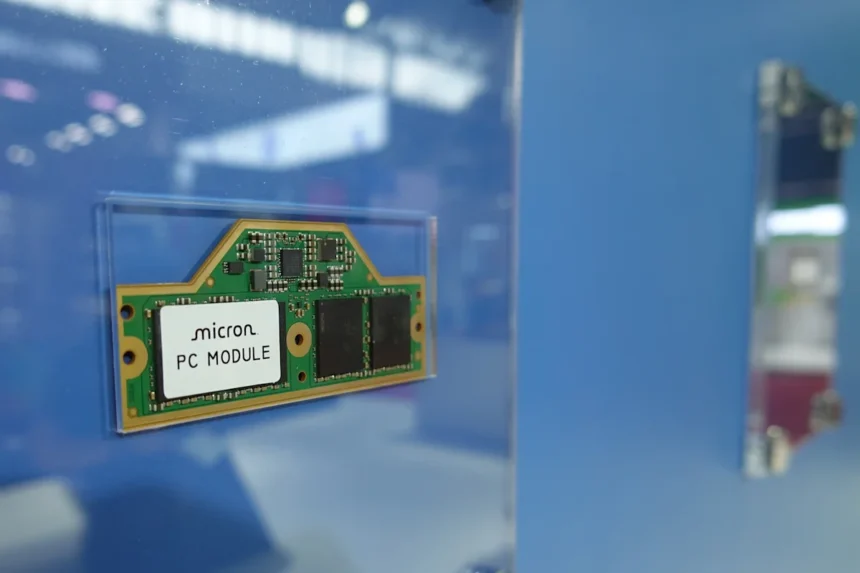
Micron, the prominent memory chip manufacturer based in Boise, Idaho, has recently captured significant attention on Wall Street, signaling a potential shift in investor sentiment. The company’s future success appears intricately tied to the ongoing AI-driven shortage of memory chips, a situation that has created high demand for their products.
In a notable trading event, Micron’s market valuation briefly surpassed that of tech behemoths Meta and Tesla, showcasing its skyrocketing stock value and the confidence investors have in its long-term prospects. While Micron’s valuation fluctuated, closing Friday with a market cap of approximately $1.27 trillion, it nearly matched Meta’s $1.39 trillion and Tesla’s $1.42 trillion. The surge in Micron’s stock price has been remarkable, with an increase of over 236% in just the past month, finishing at $1,132 a share by the end of the week. This is in stark contrast to its years-long trade below the $100 mark, revealing a transformative phase for the company.
Historically, Micron was largely recognized for producing small memory cards essential for enhancing the storage of PCs and smartphones. However, the current energy in the tech sector, particularly driven by the explosion of AI technology, has altered the narrative. Micron is now benefiting from an unprecedented data center build-out aimed at supporting AI applications. This has led to a substantial surge in demand for system memory chips, especially DRAM and NAND, the types Micron specializes in, with a particular emphasis on High-Bandwidth Memory (HBM). An average AI server demands significantly more memory than the typical laptop, thereby intensifying the strain on supply.
Major players in the AI sector, including Nvidia and the tech giants building their own infrastructure—such as Microsoft, Amazon AWS, Google, Meta, and Oracle—are rapidly purchasing large quantities of memory. This escalating competition has prompted other companies that rely on memory, including PC manufacturers like Dell and HP, to also begin stockpiling supplies. The situation has resulted in a supply crunch, informally labeled “RAMageddon,” which industry experts suggest may endure until 2027. The repercussions of this shortage have already begun to impact the prices of consumer electronics like Apple products and Xbox consoles, further highlighting the urgency of the demand.
In light of this environment, Micron’s recent third-quarter financial results indicate significant growth. The company reported a staggering quadrupling in revenue year-over-year to $41.45 billion, and profits soared from $1.88 billion to $28.2 billion during the same timeframe. Additionally, Micron projected a positive outlook for the fourth quarter, estimating revenues between $49 billion and $51 billion, which has led to growing enthusiasm from Wall Street regarding the potential of AI-related companies.
However, the traditional challenges faced by memory chip manufacturers, such as the lengthy and costly process of building out manufacturing capabilities to increase production, remain a key concern. Often, such expansions happen just as demand begins to wane, leading to excess supply and price drops. Despite these risks, Micron has proactively sought to mitigate them by securing a number of long-term supply agreements with significant clients, including Nvidia and the AI lab Anthropic. The company announced that it has signed 16 strategic customer agreements across various sectors, expecting these partnerships to fundamentally transform its business model.
Some analysts have expressed increased optimism regarding Micron’s potential for sustained growth. For instance, tech analyst Sebastien Naji from William Blair emphasized that demand is likely to continue outpacing the rate at which new manufacturing facilities can come online. His research note suggested that the current landscape calls for stable average selling price (ASP) growth in the upcoming quarters, alongside improved revenue visibility thanks to a rapidly expanding suite of long-term agreements with key customers. Naji reiterated his favorable outlook, suggesting there is a genuine potential for durable earnings growth.
As Micron navigates these dynamic market conditions, the question remains whether the company can maintain its momentum and avoid the pitfalls typically associated with the cyclical nature of the memory chip industry. For the time being, it stands as a remarkable case in the tech sector, having briefly outshone some of its larger counterparts, marking a pivotal moment in its ongoing evolution.