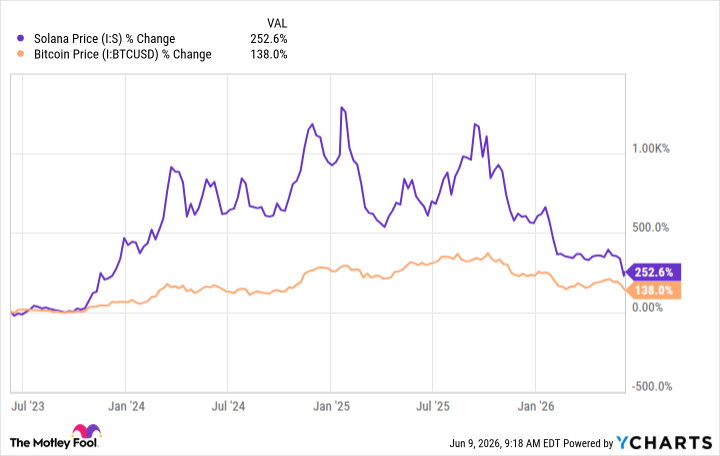
As the cryptocurrency market continues to evolve, particular attention has shifted towards altcoins that have shown remarkable resilience and growth potential. Solana has emerged as a standout contender among these alternatives, boasting an impressive increase of over 250% since its initial rise in popularity during 2020 and 2021. In contrast, Bitcoin, the reigning leader in the cryptocurrency space, has experienced a more modest gain of nearly 140% during the same period.
Despite Bitcoin’s position as the largest cryptocurrency and its appeal as a safer investment, it faces pressures typical of the broader market. Bitcoin has seen a decline of 10%, bringing its price down to approximately $61,658 as of June 10, while Solana suffered a more significant drop of 24%, now valued at around $65. Factors such as inflation and geopolitical uncertainty have contributed to these fluctuations, as higher inflation often leads the Federal Reserve to raise interest rates, making riskier assets like cryptocurrencies less attractive.
Nonetheless, long-term improvements in cryptocurrency fundamentals hint at a more favorable future. Solana, in particular, is well-positioned for growth in mainstream financial applications. Its blockchain technology not only supports efficient payment methods but is also being explored for potential use by artificial intelligence agents—autonomous software that requires a secure and transparent medium for transaction execution.
While mainstream integration of blockchain technology has been slowly progressing, recent movements by established financial institutions signal a shift. Companies like Visa and Mastercard are actively working on stablecoin products, and major banks are starting to incorporate stablecoins into their operations. This growing acceptance of cryptocurrency underscores the technology’s potential to transform traditional payment methods.
Solana’s intrinsic design incorporates smart contracts natively, allowing for more seamless development of decentralized applications. Conversely, Bitcoin must rely on additional blockchains or Layer-2 solutions to implement similar functionalities, which has led to institutional players increasingly favoring Solana for critical operations such as stablecoin settlements.
The advantages of Solana extend further into its cost-effectiveness for microtransactions, an essential feature for the future applications of AI agents. These agents could revolutionize how transactions occur, necessitating fast and affordable methods of transferring value, an area where Solana’s attributes shine.
In conclusion, while Bitcoin remains a safer and more established choice in the cryptocurrency market, Solana’s speed, adaptability, and ability to cater to emerging needs in AI and finance position it as a formidable competitor. With a market cap about 3% of Bitcoin’s, there is significant potential for Solana to outperform Bitcoin over the next few years.
Investors considering adding Solana to their portfolios should do so with careful thought, especially given that other stock options may yield more substantial returns in the coming years as highlighted by analyst recommendations. As the cryptocurrency landscape continues to develop, Solana’s unique advantages may well set the stage for sustained growth.