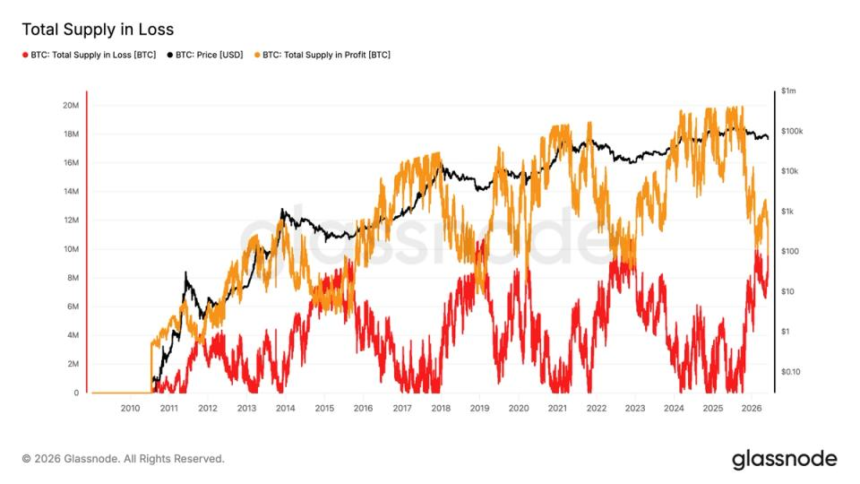
The Bitcoin market has recently witnessed a significant shift as the supply held at a loss surpassed 10 million BTC, a pivotal threshold indicating deeper bear-market conditions. Data from Glassnode highlights that this loss peaked at approximately 10.5 million BTC when the cryptocurrency’s price dipped to about $61,300. With the total circulating supply estimated at around 20 million BTC, more than half of all coins in circulation are now classified as being in an unrealized loss.
In contrast, the supply held in profit has fallen to approximately 9.8 million BTC. This marks a notable first in the current market cycle, where the quantity of Bitcoin held at a loss has outstripped that held in profit. Historically, such a transition has typically occurred during profound bear-market phases, often aligning with significant market bottoms.
Reviewing past cycles provides further insights. For instance, during the 2015 bear market, the supply balance between loss and profit remained nearly stable for nearly a year before a recovery ensued. In contrast, the 2019 cycle showed this equilibrium lasting about six months. The downturn triggered by the COVID-19 pandemic in March 2020 was shorter, with the coin remaining below these thresholds for roughly one month. More recently, the bear market of 2022 exhibited this trend for approximately six months, highlighting the varied duration of these critical market conditions.
Adding further significance to the current market dynamics, Bitcoin recently tested its 200-week moving average, hovering around $61,300. This long-term trend indicator has consistently served as a major support level during previous bear market cycles. Should Bitcoin fall below the psychologically significant $60,000 mark, the next major support level would likely be around $54,000, coinciding with the realized price. The realized price represents the average acquisition cost of all Bitcoin in circulation, calculated based on the price at which each coin last moved onchain. Historically, Bitcoin has traded beneath its realized price during every major bear market.
As the market continues to fluctuate, this latest trend raises questions about the potential duration of Bitcoin’s stay at depressed levels, emphasizing the unpredictability and volatility inherent in cryptocurrency markets. Investors and analysts are now closely watching these developments, as they could signal broader trends in market sentiment and price movements in the future.