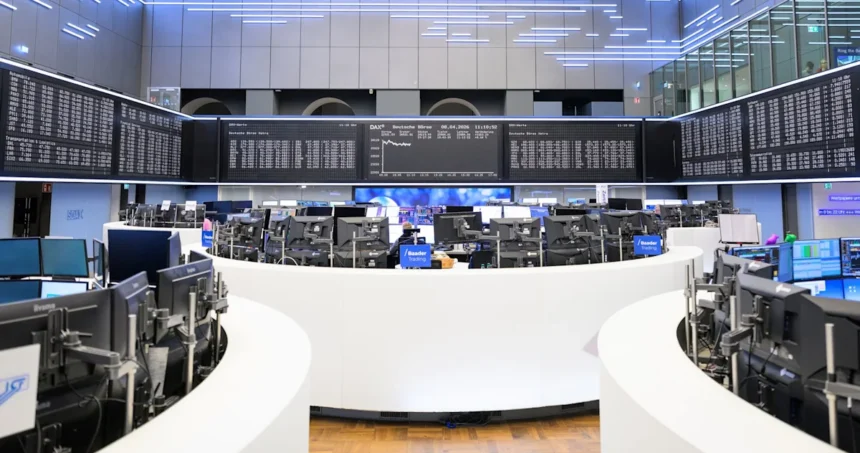
European stock markets exhibited weakness on Friday, reflecting investor caution amid rising uncertainty surrounding the possibility of a lasting peace truce between the United States and Iran. This unease was amplified by the abrupt cancellation of negotiations in Switzerland, coinciding with renewed hostilities between Israel and Hezbollah.
The pan-European Stoxx 600 index declined by 0.24%, with several major indices following suit. The UK’s FTSE 100 fell by 0.35%, Germany’s DAX decreased by 0.16%, and France’s CAC 40 experienced a more substantial drop of 0.55%. In contrast, Switzerland’s SMI managed a marginal increase of 0.06%.
Not all markets mirrored this trend; several countries such as the Czech Republic, Denmark, Greece, Norway, Poland, Portugal, and Sweden closed in positive territory. However, Finland, the Netherlands, Russia, Spain, and Turkey ended lower. Austria, Belgium, Iceland, and Ireland remained unchanged.
In the UK, mining stocks bore the brunt of the day’s losses. Notable declines included Antofagasta, down 6.1%, and Fresnillo, falling 4.65%. Other prominent companies like Endeavour Mining, Anglo-American Plc, and Rio Tinto also saw significant drops, closing down between 2.57% and 3.3%. BHP Group’s shares fell by 4.3% after the company revealed plans to record a $2.3 billion impairment charge related to its Jansen potash project.
On the brighter side, BP’s shares rose by 2.81%, while National Grid gained 1.8%. LSEG, Informa, Experian, and several other companies also registered modest gains.
In Germany, Volkswagen’s stock slipped by 4.3%, while other big names like Adidas and MTU Aero Engines also ended the day lower. Conversely, Rheinmetall enjoyed a 2.7% increase, along with gains in Bayer, Porsche, and BMW.
The French market saw L’Oreal, Kering, and others declining by 1% to 2.3%, while Renault experienced a remarkable uptick of nearly 4%. Companies like Sanofi and TotalEnergies managed to post moderate gains.
Economically, new data from Destatis revealed that Germany’s producer prices climbed at their fastest rate in three years during May. This rise was chiefly driven by increased costs of intermediate goods and energy. Alongside this, retail sales in the UK saw an unexpected boost of 1.2% in May, in contrast to a decline in April.
Despite these signs of growth, consumer confidence in the UK remained low according to GfK survey data, holding steady at -23. Analysts warn that this subdued confidence is vulnerable to further economic or political uncertainties, emphasizing the need for careful monitoring of the situation as it develops.