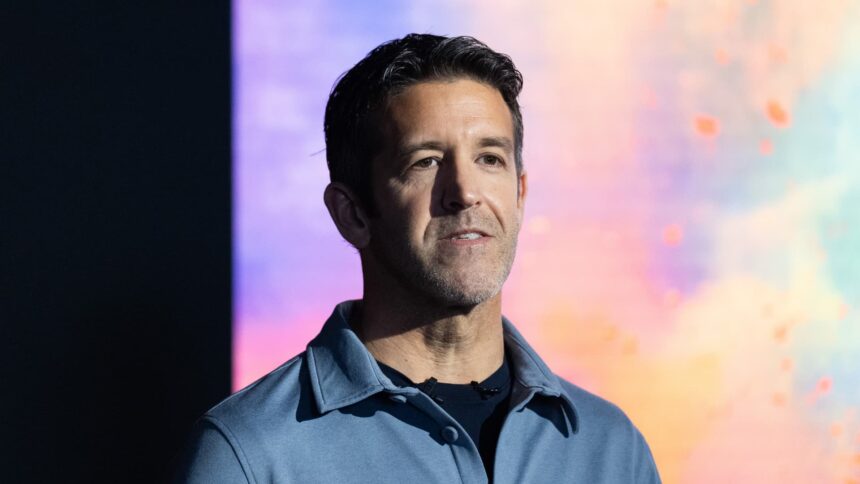
Apple’s unexpected leadership change has sent ripples through Wall Street, prompting investors to reassess their expectations for the tech giant. On Monday, the company announced that John Ternus, the senior vice president of hardware engineering, will take over as CEO on September 1. Tim Cook, who has steered the company for nearly 15 years, will transition to the role of executive chairman.
Following this announcement, Apple shares dipped approximately 0.5% in after-hours trading, raising concerns that the stock could end the year negatively, despite currently being up just 0.4%. Since Cook assumed leadership in August 2011, Apple shares have surged more than 1,930%, while the S&P 500 has increased around 504% during the same period.
Many investors were caught off guard by Cook’s decision to step down now, believing he would maintain his role for a longer duration. However, there is a degree of optimism surrounding Ternus, especially given his hardware background. Gene Munster, managing partner at Deepwater Asset Management, expressed that while the leadership transition is significant, the market might respond positively to Ternus taking the helm at one of the world’s largest companies. He suggested that Ternus might make significant hires from AI-focused firms like Anthropic and OpenAI, signaling a strategic pivot without directly competing in the language model space.
Gil Luria, head of technology research at DA Davidson, noted that Ternus’s appointment indicates Apple may be focusing on future hardware innovations, such as augmented reality glasses or a foldable smartphone. “They can let everybody else compete on that front and then just leverage the winning result,” Luria stated.
Some analysts remarked that the emphasis on hardware is a logical step, particularly given that Apple has not had significant success in hardware innovations recently. Dan Nathan, principal at RiskReversal Advisors, highlighted the need for new products to drive revenue growth from $400 billion to $1 trillion. Patrick Moorhead, founder of Moor Insights & Strategy, also mentioned that Ternus would likely prioritize operational efficiency and margin management.
As Cook departs, his tenure is remembered for a unique blend of corporate leadership and political navigation, especially during challenges such as President Trump’s tariffs. Analysts suggested that Cook’s business strategies, including stock buybacks and dividend distributions, have attracted value-focused investors like Warren Buffett.
While some speculate that Cook’s exit is timely within a rapidly evolving tech landscape, questions remain about how Ternus will adapt to the challenges presented by the ongoing AI revolution. Investors are keen to see how Apple will incorporate AI into its products, as the sector’s players might look to branch into devices traditionally dominated by tech giants like Apple.
Despite the uncertainties, many analysts, including Wedbush’s Dan Ives, anticipate a solid earnings report from Apple next week, arguing that Cook is unlikely to announce his retirement amid a turbulent period for the company. Market participants are also keenly watching the upcoming Worldwide Developers Conference, particularly in light of developments related to Siri, which may help shape the outlook for Ternus’s leadership.
As of Friday, Apple shares closed at $273.05, with most investors maintaining a buy rating. Metropolitan Capital Advisors CEO Karen Finerman advised caution, suggesting that no immediate reactions to the news should be taken, as the core story of Apple remains intact.